Food has been a pervasive theme in art since antiquity. The act of eating itself is timeless and unites us across time and space for it is something we share in common, a consequence of the basic human condition. Food makes up a big part of our everyday life. There are few things as pleasurable as savouring a fine dish or as ritualistic as our mealtimes. As a social activity, it also brings people together. As a result, the borrowing of food themes as metaphors and symbols for diverse concepts has been steadfast and persevered throughout the ages. Here, I will be discussing a few paintings that feature various ‘eaters’ and the wider significance of each composition and their commentary on morals values , eating norms, society or even life and death itself. Hungry to know more? Let’s not wait any further and dig right in.
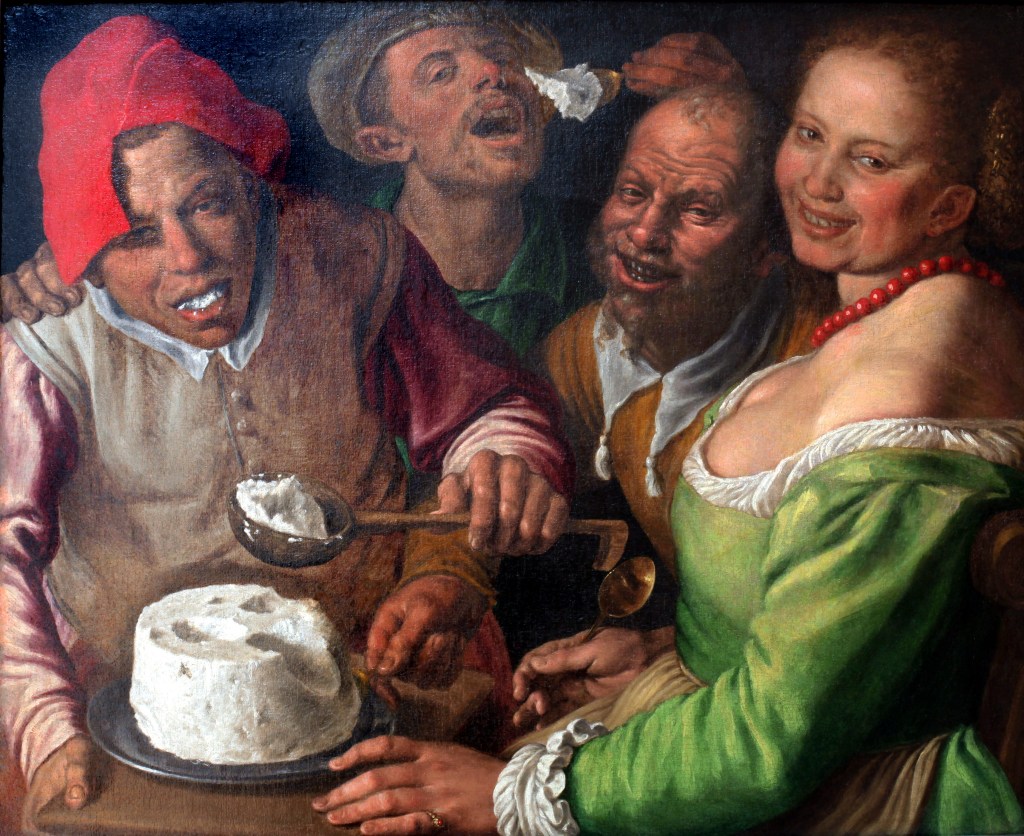
Vincenzo Campi’s Ricotta Eaters features a quartet of three men and a lady reminiscent of a Caravaggesque half-body close up prediliection. I guess calling her a lady would be too kind as she looks anything but. Dressed wantonly in a tight emerald dress and proffering her cleavage for her companions through her body language, she looks unabashedly into the viewer’s eyes. They encircle a great serving of ricotta on a dish which looks suspiciously like a human skull, an iconic symbol of death in these earlier days. The man on the right shows zero regard for etiquette as he scoops up a mouthful of ricotta on a wooden ladle, looking almost drunk with pleasure. His mouth is half ajar, showing the unsightly contents of the half chewed cheese. His other companions seem less interesting in the dairy produce. The man next to him seems to be tasting the dairy product as an appetiser in a nonchalant manner, seemingly waiting for the bona fide main dish to arrive. Indeed, ricotta is really the side dish or the appetiser of what is to come. This group is not the ricotta lovers club for sure, and they have gathered for something that is probably way more sinful than the delicious dairy produce they are having.
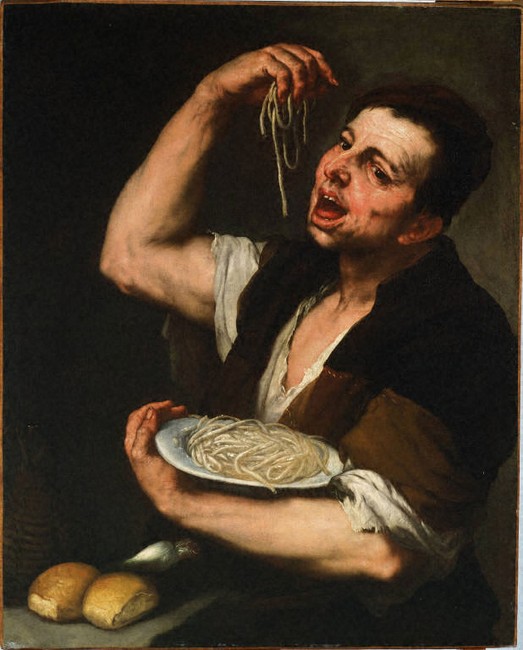
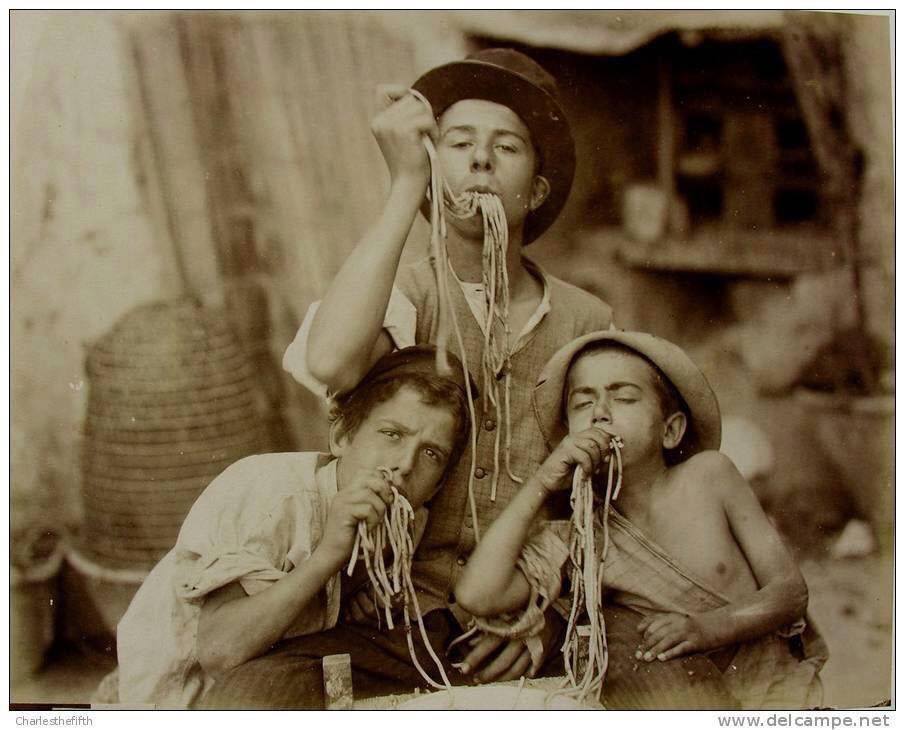
Equally lacking table manners is the Pasta Eater in Luca Giordano’s Pasta Eater(Allegory of Taste). The unknown man(probably a peasant from his humble outfit), is seen grabbing a handful of maccheroni (17th Century Neapolitan name for any variety of pasta). Probably enough to horrify any present day Italian, this was the usual method to devour a piping hot plate of pasta boiled in meat broth. Pasta, by the seventeenth century began to be the staple food because due to the rising cost of meat and proved to be a very affordable option for lower class individuals. Sold by street vendors, such dishes were consumed on the go, much like the modern day sandwich. Ready made durum-wheat pasta was mixed in large open troughs and treated by “torchio” (screw press), and pasta strands were draped from ready made stands or splayed over giant cloths to to dry under the glorious Italian sun. Large cauldrons contained the Italian staple food, bringing them to a boil and finally the dish is garnished with pork grease, salt, and grated hard cheese. The famished consumer would then dig into his purchase on the go with his bare unsanitary hands, along the flea infested market. Giordano’s artwork belongs to a series on the allegory of the five senses, and uniquely portrays a highly peculiar street food culture Naples. The consumption of pasta has notably gone from strength to strength in Italy, and is still widely consumed in the Mediterranean country. I personally, am extra grateful for the invention of the mighty fork to enjoy my pasta today.
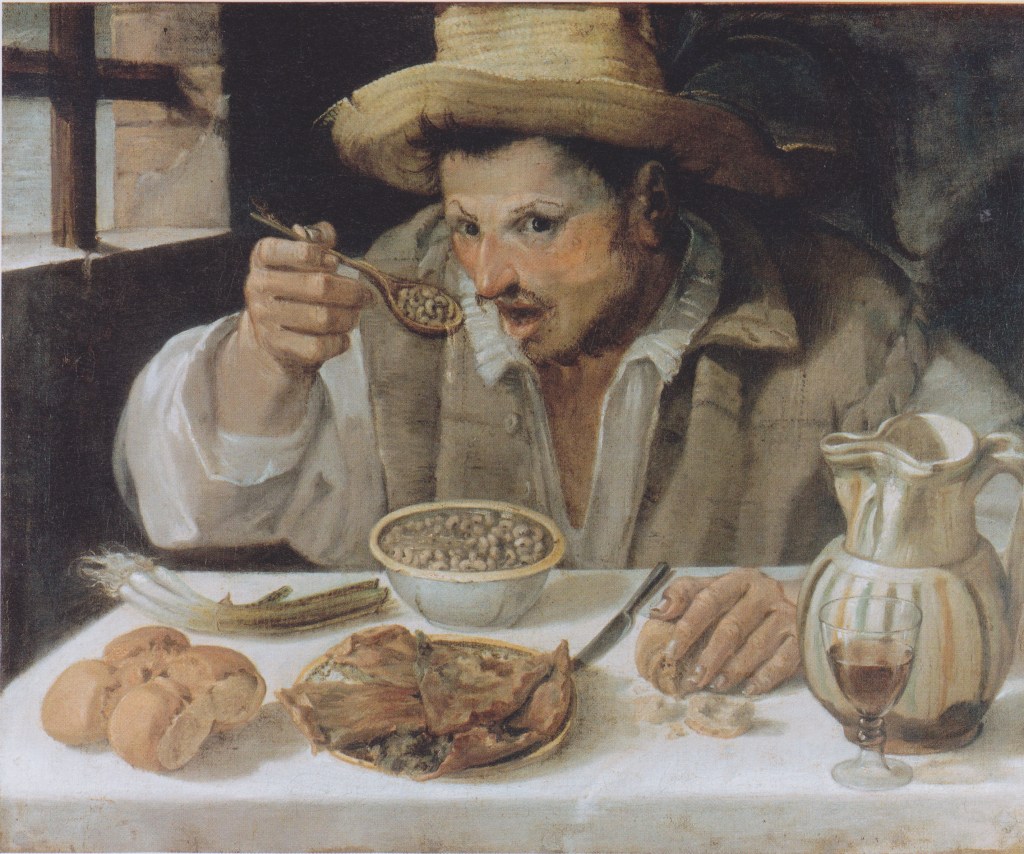
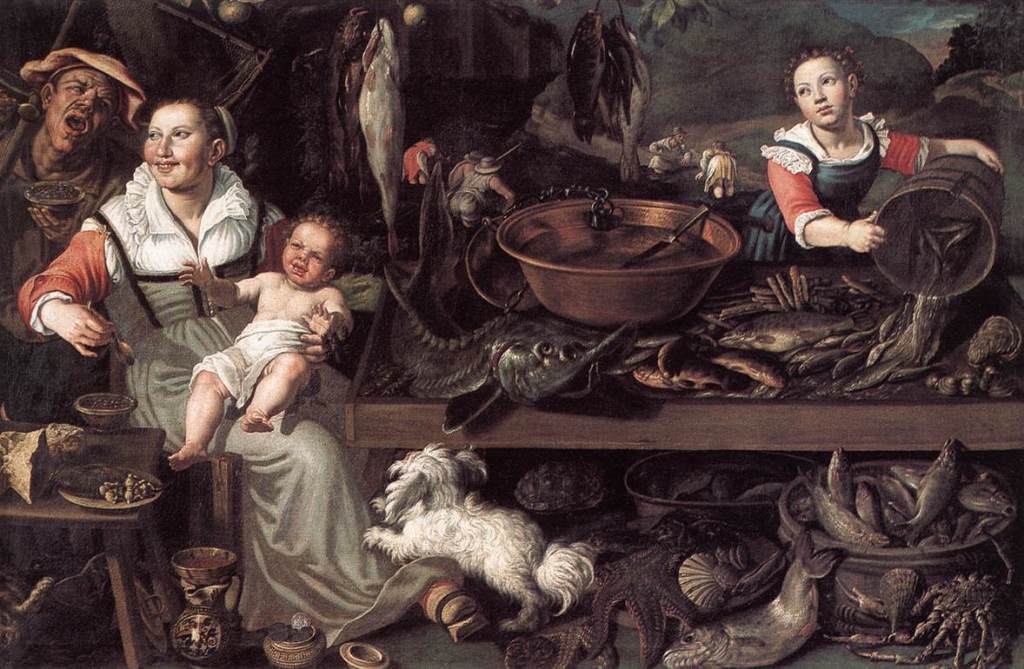
Here, the subject of the bean-eater is borrowed from Vincenzo Campi’s The Fishmongers. The bean-eaters are seated on the left on Campi’s painting, and the characters are seen tucking into exactly the same meal as Carracci’s peasant featured here. In Campi’s version, the characters are feasting in the same questionable manner as their counterparts in The Ricotta Eaters. In The Fishmongers, the male’s open mouth, the curvaceous lady’s smile that knows more that she lets on, and the crying baby all collectively suggest lust. Significantly, produce such as beans, leaks and onions were regarded as seventh century aphrodisiacs, making them their version of our oysters. it seems that here, the beans is about to be spilled on some lascivious act that has already happened or is to come.
Although Annibale adapts the subject of bean-eating from Campi, his representation of the subject is completely different. There is nothing vulgar or crude about Carracci’s farmer. He is dishevelled and does not appear wealthy, but he eats with quiet dignity. Judging from his attire, he is probably on his lunch break from hard labour, but the spread laid out infront of him is that of a formal dinner fitting for a gentleman. Further lending this male the air of nobility is the elegant white, beige and neutrals palette that defines this picture. The humble menu consisting of vegetables, bread, onions and a half glass of wine next to a caraffe all laid out tastefully. He digs into the dish of white beans with a wooden spoon almost pensively. Due to religious reasons as well as rising costs , meat was taken sparingly, which led to the rise of legumes and noodles. Its interesting to see an adaptation of the same dish in two very different ways, and in this case, two contrasting takes on the same dish.
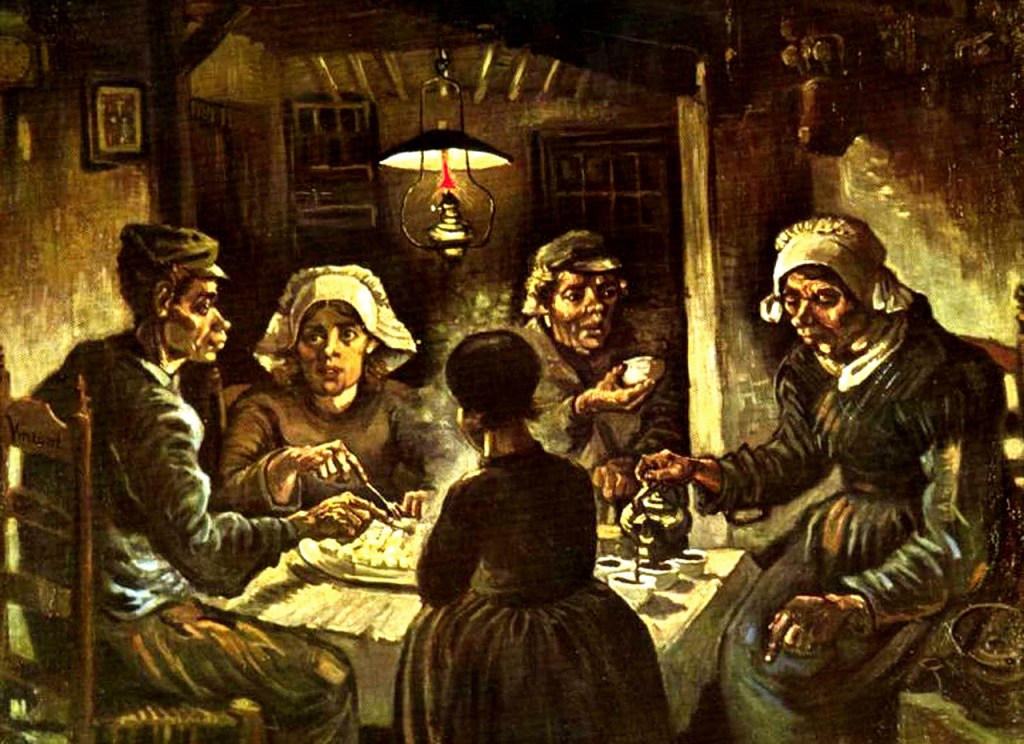
The Potato Eaters was one of Van Gogh’s most ambitious artistic endeavours, featuring a group of peasants in an impoverished setting filled with a palette of cool grey, greens, blues. Contrasting from his signature hues in his landscape paintings, the sombre tones match the earthy quality of the work perfectly. The rough characters in the artwork also mirror the unpolished brushstroke of VanGogh’s hand, as the artist imagine ‘ploughing my(his) canvas as they do their fields.’ As in Carracci’s painting, there is a proper dining space despite the humble atmosphere. A lady is pouring coffee while she surrounds this dining area with her family. The dish of the day is piping hot homegrown potatoes. in his letter to his bother Theo, the artist famously said if this painting ,’it could be a worry to give a painting of peasant life a conventional polish’ and that ‘a painting of peasants should not be perfumed.’
This work is Van Gogh’s search for a greater spiritual truth that was influenced by his own upbringing as the son of a Minister, and is somewhat of a protest against middle class French society and modernisation. His familial portrayal of a family’s almost reverent treatment of the root vegetable is somewhat a painted vision for Van Gogh who was born into money, but always felt rejected by his family and aspired towards the peasant life. This painting is the antithesis of who Van Gogh was born into, but who he aspires to be. It is also a quietly epic commentary on the pretences of contemporary French society and the search for the ultimate spiritual truth executed in the most authentic fashion possible.
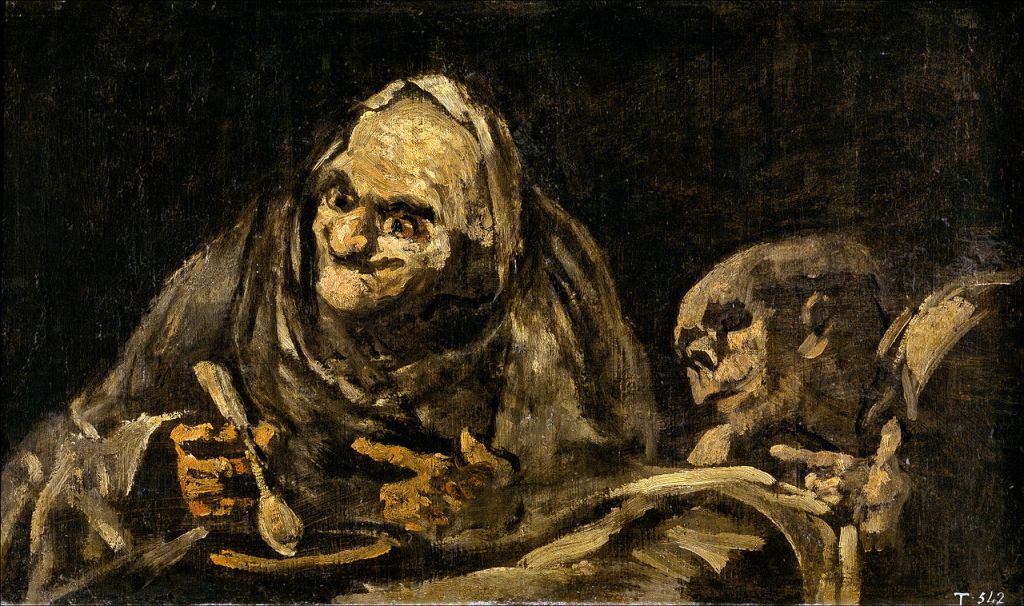
Francisco Goya, Two Old Men Eating Soup, 1819-1823
This horrific work that once rested on a wall looks as if it came out of a coverpage of a medieval spellbook. It belongs to a series of paintings by Goya done in his mid seventies at the Quinta del Sordo(House of the Deaf Man). Profoundly broken and suffering from the loss of hearing, this painting was one among the others that look like it came right out of the horror movies. As Goya never intended to paint this for a public audience , he never made any commentary on this series. The alternate name given to this work was Witchy Brew which solidifies the disturbing quality of his paintings. Although a very mundane setting is expected due to the everyday act of eating, the lighting and depiction of the two old people up the spine-chilling effect. The elderly seem barely alive, and the right figure looks almost like a human skull. Probably missing their teeth, they are eating soup which seems contradictory as people who look barely alive don’t need sustenance, which makes the act of eating barely necessary.
But as the Jewish saying goes , ‘worries go down better with soup than without.’ To fill up their stomachs or to be able to swallow their problems metaphorically, your guess is as good as mine. What is fairly certain here is that this wall painting epitomises the greatest fear of Goya. Old age and death definitely becomes more and more real for someone when one is in his twilight years and suffering from an ailing body. Perhaps by personifying his fear through these two figures consuming the traditionally comforting dish, a dish that Goya himself probably found easy to digest at his age, he hoped that he would find his fears be equally palatable.
In conclusion, this post has dissected some of the wider significance of food in art. Although food as been represented since time immeasurable, food culture actually evolves with time alongside the art that engages with it. In Vincenzo Campi’s Ricotta Eaters, we see how the ricotta (a staple food for the low income) acts as an appetiser for morally dubious activities. Luca Giordano’s Pasta Eater acts as a sign of the times of the mangiamaccheronni, a surprising eating norm in Naples that demonstrate how eating norms have changed. One thing that remain unchanged though, is that pasta is still the staple food in the Southern Mediterranean country, albeit a dish that has to be served with a proper dining setting in a restaurant.
Another important food item, beans were given a dignified treatment by Carracci, portraying a man enjoying his lunch of white beans as he takes on a break from an honest day’s work, which greatly contrasted Vincenzo Campi’s rendition of the same dish. Van Gogh’s portrayal of a simple familial dinner over potatoes and coffee was a social, spiritual commentary as well as a search for the greater truth, whatever that might be. Goya’s soup eaters on the other hand, was an actualisation of the Spanish master’s greatest fears about old age and death. As the old saying goes, many cooks spoil the broth. In this case, there is no such thing. Let us all savour this metaphorical broth and bring our life experiences and varied perspectives to these paintings we are analysing. After all, everyone’s taste is different, and variety is the spice of life. At this feast of art appreciation, the more the merrier is a must-have attitude.
 writingaboutpaintings
Leave a comment