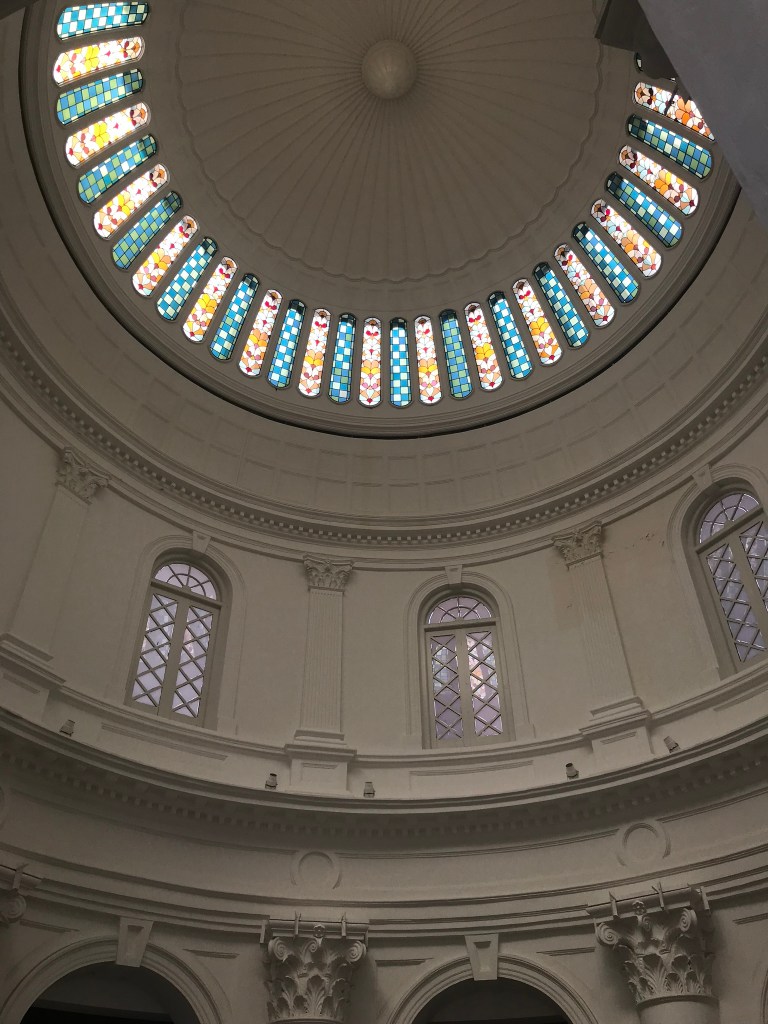
Just because I belong to the field of art, some people decided that they should only visit the museum with my company because they made me the so- called authority on the subject. That is further from the truth, as a three year degree in Art History can only teach me with so much. The most important thing I learnt from University gives me a basic set of skills in art analysis, but then I get thrown out into the wild just as any of us. I definitely do not know about every single art form out there in the world. I don’t know of any Art Historian who would. But I admit that I do know where to start trying, when faced with a piece of art where very little information would be available to me.
If I had to say that I have any advantage over anyone, it would be the fact that I thoroughly enjoy museums , and in the last decade, visiting museums became part of my hobby, my travel plans as well as a place where I have time to myself. I don’t have a specific learning aim, and I take it as a leisurely afternoon out. But on many of such leisurely outings, I gather knowledge even if it’s not a happening at a conscious level.
The museum is indeed a special place and I cannot deny that I was once like the others , who thought that the museum was exclusive , unavailable and needed some sort of special education to navigate and comprehend. Indeed, I once felt that the museum was a secret place only for special people. A sacred space. Mysterious as the pyramids of Egypt , timeless as the temples of Greek antiquity, and as unreachable as the furthest flung places of the earth. Access to this special world was only for a chosen few and how marvelous it would be if I could understand this world and earn my right to be in such a place of privilege.
It was only later that I learnt that art is, on the contrary, a space that unites people, where boundaries are removed and that everyone has the basic right to enjoy art. The museum is not for chosen ones , or a particular class of people. It’s a place for contemplation, reflection, education, and builds up on visual literacy which is a fundamental way we understand each other without the burden of language barriers . The museum is an all-welcoming institution, a safe space for contemplation and reflection. Indeed, as man words in the English language, the word ‘museum’ has classical roots where the Greek equivalent ‘mouseion’ refers to the ‘seat of the muses’, an institution of contemplation and philosophy. So don’t hesitate to make yourself at home and soak in the calming energy of the museum where time stands still and your thoughts can sound succinct and louder. Here are also some tips for you if you are a museum noob, and need some help in the initiation process to this wonderful space.
1.Look up opening hours on the internet. Duh! Museums are closed on Mondays Italy due to some reason , which is not what one would usually expect. Nothing bums me out more than going to the museum and realising that it is closed for business
2. Check if pre-booking is required for the museum visit. I learnt this the hard way.
3. Buy a city pass. Single entry prices are usually more expensive. The Firenzecard (Florence’s city pass) is particularly worth it in my opinion.
4. Look for clues from the title of the work. The title of an artwork directs you on what to focus on when evaluating the work. This post might be helpful if you are interested in the subject! https://renee-phillips.com/think-titles-art-matter/
5. Make sure you fuel up before venturing into gigantic galleries such as the Louvre. Museum cafes often offer pathetic food choices and almost always cost a bomb . I almost always get hungry before even completing half of a museum visit and detest being torn for choice between paying a bomb for a sandwich in the museum or cutting my museum visit short because the only thing I can see in front of me would be is a can of Pringles instead of a Pollock.
6. To avoid being overwhelmed by the sheer volume of displays, I try to look up the highlights of the museum and the works I want to see first . This is more applicable when I only have one day to visit a museum of colossal collection, which unfortunately is almost always the case. Don’t beat yourself up if you can’t see everything.
7. For paintings that are famous, you may find a sea of people all rushing to take it in at the same time. Take a picture of the label of the artwork containing the title and other content, where you can read and behold the work from a comfortable distance.
8. Sometimes, the most hyped up art piece of the museum might not be the most worthy piece. Correct me if I am wrong, but I personally feel that there are many artworks as worthy , or even more interesting than the Mona Lisa. I cannot help but cringe whenever I visit the Louvre and see a whole bunch of tourists jostling to be infront of the Mona Lisa. There so many other great art at the Louvre , my dear people!
9. Look the artist up online, and read up on some quick facts on his or her style. A technique that I frequently use with my students are ‘I See, I Think, I Wonder.‘ Consider what you see in front of you. It can be as basic as the colour , or the subject matter that is depicted. Using some of the facts you have gathered online as well as whatever is available in front of you (for instance, the title) to link what you see in front of you to what you know. Think about the possible connection between what you know and what you think could be the connection. For example, I see the use of the colour blue, I think the artist was trying to use the colour to represent melancholy. Wonder about other aspects where the facts are not available to you at the moment. Why is the the lady in the portrait not smiling ? Is the landscape depicted in the background a real place? Let your imagination run free!
10. Try to relate that piece of art in front of you to yourself. We know that famous saying, a picture paints a thousand words. What is that picture in front of you trying to tell you? What can you read from it? What can you not read from it? Do you like it? Do you not like it? Just because you do not like every form of art that you see, or cannot comprehend what it’s trying to portray doesn’t make you any less intelligent. Art is subjective for a reason! It speaks to every individual at varying levels. That’s the lure of the subject!
11. Context, context, context! Consider the fact that the piece of art in front of you has been moved from its original context . It could have been in a sun dappled Greek temple or in a dimly lit church lit by soft candle lights. It could have been in a private collector’s home. Now it’s sitting in a museum, framed. Consider the lighting and the framing. How has it shaped your perception of the work? I will include a fascinating article from the Guggenheim on the topic of framing. Hope it fascinates you the same way as it did for me!https://www.guggenheim.org/blogs/checklist/lets-talk-art-whats-in-a-frame
12. If the museum allows, take some pictures of interesting artworks that really spoke to you in the exhibition. New ideas might strike later on. It could also be a good conversation starter when meeting new acquaintances or at dinner party conversations. My friend introduced me to his American language exchange partner who was holidaying in Rome the same time as I did. Little did we know that we actually visited the same exhibition Bacon, Freud and The School of London at the Chiostro del Bramante on the same day. As I took a great number of pictures at the exhibition, we were able to discuss some of the works that we obviously didn’t get to see together while we laughed at how serendipitous everything was.
13. Observe museum rules such as taking pictures without flash, as well as standing within the demarcation allowed. Art is sometimes about breaking rules and conventions. But don’t try it at the museum, please.
14. If for some reason you cannot visit a museum,you are bored with the local offerings, or suffer from some sort of museum phobia, you could check out Google Arts and Culture. It is an amazing site that is also available as an app. Artworks can be viewed very close-up, such that you can see the brushstrokes of the artist as if you are standing in front of the collection. Paintings are categorised in sections such as movements , mediums, colours , etc. You could even take three-dimensional virtual tours of museums, monuments, and other sites. Within a second, you could be transported to another continent. The interface rocks, really. Pretty handy in this climate of the pandemic isn’t it?
15. Last, and maybe really the least, avoid the giftshop on your way out. You don’t really need an overpriced low quality souvenir stationery to commemorate your trip to the museum. It’s your call, though.
 writingaboutpaintings
Leave a comment