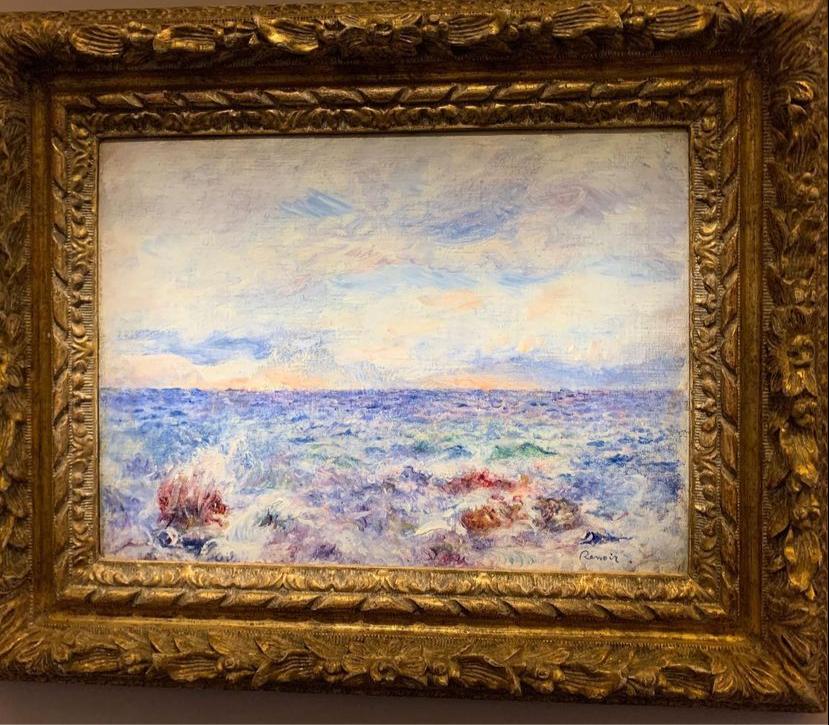
Pierre Auguste Renoir , Capri, 1881
As the saying goes, mens sana in corpore sano. The Roman poet Juvenal who coined the term highly prized mental health. His inspirers, found in the ancient Greeks were in the same pursuit of the same ideal, as physical and mental wellness both were closely correlated in ancient Greek society. In Auguste Rodin’s The Thinker, one can see the idealistic culmination of the perfect human condition in this statue. A well- built man who might remind you of the regular at your local gym sits on a rock, pensive and deep in thought. His strong, muscular physique is not random , but is symbolic in its representation of thinking as a strong ‘activity’ in a tangible way represented by the robust physicality of the man. It had long been debated who the sculptor was trying to represent, some say the famed Florentine poet , Dante Alighieri, but universally, this masterpiece has come to symbolise everyone uses their imagination, such as artists , writers and even scientists.
The Thinker was representative of the ancient Greek concept of Kaloskagathos, where the Greeks firmly believed that a beautiful body was considered direct evidence of a beautiful mind. Euiona, another more uncommonly known Greek term, denoted a mind that was well or ‘beautiful thinking’, or a state of mental wellness. Rodin’s famed sculpture aligned very much with these ideas even though he didn’t belong to any of these ancient societies. This only demonstrated the longevity and validity of this belief; that one who had a beautiful mind was able to think rationally and this was because he or she was in a constant state of mental equlibrium.
Indeed, we take the act of thinking lightly. It seems to be the most nondescript and passive activity that no one pays attention to. But to be able to think for anyone who was troubled in their minds such as thoughts disorders or other issues, would make this process highly challenging as mental issues affects thinking in and can lead to problems with how the brain processes information and may result in abnormal mood, thinking, perception, or behavior.
Art has always gone hand in hand with the pursuit in mental and and physical wellness, evident in the countless Greek and Roman masterpieces that continue to awe their beholder . The Greeks and Romans exemplified superior capacity in rationalising and reasoning, and probably sharpened their cognition through constant art creation. Erroneously, art has always been perceived as hands-on in nature, but few actually notice the cognitive involvement that takes place when one is creating a piece of art. For instance, honing our psychomotor skills would develop directly as a result of movement tasks require both cognitive and motor processes. It is in our scribbles, doodles, paintings and drawings that we mentally connect with ourselves and with others, increasing our connection between our movements and our mind. It is of no wonder then, that since art involves the mind so much, it can greatly influence our mental state. My post is going to focus on six ways art can impact the mind in positive ways.
- Self Expression
Art therapy has been seen as something that appeals to elites in contemporary society, but it is probably one of the most essential coping mechanism to life. It has always been the most primordial way to connect with the world or oneself. Just look at cave paintings. Cavemen had no formal education, yet they were able to express themselves and communicate within a system they invented even though no set of written languages existed.
Forgive me for returning to the cliché of a picture paints a thousand words. It is indeed overused , but also because it cannot be nearer to the truth. To be able to express a feeling, a narrative, a story in pictorial form is the most satisfying positive form of outlet. You might have seen it in some random horror movie where a child scribbles with crayon what he is too petrified to express in words, or someone who has experienced deep trauma who would demonstrate his or her innermost psyche through a picture.
Yes, artists would be at a more privileged position self-expression artistically due to their familiarity with the devices of visual literacy, but everyone already has some innate subconscious knowledge this system at varying levels, although they might not necessarily aware of this. I have several times, conducted lessons in a visual literacy class where the kids already know on some level that the colour red signals danger , and jagged lines makes one feel more discomfort than soft curves. It is hence proven that at a more primordial level that we already know how to express ourselves instinctually. Surely, never underestimate the power of expression, for suppression makes us ill in more ways than one.
2. The Power of Colours
Ancient civilisations have discovered and harnessed the power of colours and their therapeutic effects way back in their time. They built temples dedicated fully to healing through light, with various rooms assigned to healing powers of their respective colours. Ancient Egyptian colour therapy went back to 1550 BCE in the form of ‘colour cures’ shown on papyrus, which officially makes them the pioneers of today’s modern colour therapy practice. Instead of using the colours to heal externally, ancient Indian civilisations believed colours could be used to infiltrate the body and unblock the Chakra. Their contemporaries in Greece and China also had their own version of similar forms of the remedy.
Colours are no less powerful today, and our contemporaries today still believe in the healing power of colours. Colour therapy is still very much a thing today and other than healing physically, they also heal psychologically either though the power of expression, or by the very properties they carry. Cool colours such as purples and blues bestows calmness, while warm hues embrace one with hope and energy. Colours influence our mood, our feelings and even our appetites. Did you know that the colour blue might make us less likely to finish that food delivery just ordered?
Colours could also define whole periods of our lives. We all know of the famous Blue and Rose periods of Picasso. The Spanish painter obviously went through some bad patches in his life , and wallowed in a period dominated by colour themes. After his bad patch was over, and he let go of obsession with the melancholic blues, he began to transition into the Rose Period , picking himself up emotionally with joyous subjects matters that went hand in hand with the warm tones. His compatriot, Francisco Goya also dedicated his anxieties of aging, bad health and solitude to dark themed works, surrendering his golden years to the depths of the ‘black paintings’, coupled with semi-horrific themes and subject matter.
Colour field painting employed colours in a different way. Colour Field artists used colours as openings to draw in, immerse and to transport their viewers to a different plane. Some viewers see Mark Rothko’s atmospheric paintings as portals to a metaphysical mental space. He famously said that he was only ” interested in expressing basic human emotions — tragedy, ecstasy, doom, and so on — and the fact that lots of people break down and cry when confronted with my pictures shows that I communicate those basic human emotions… The people who weep before my pictures are having the same religious experience I had when I painted them. And if you, as you say, are moved only by their color relationships, then you miss the point!” For the artist’s followers, beholding his huge, color-drenched paintings equals the experience of visiting a temple. Even though Rothko is adamant that you shouldn’t focus on colour, I would like to see a Rothko without colour , in the vein of his abstract expressionist brother, Pollock who only painted in shades whites , blacks and greys. It just doesn’t happen.
3. The Legend of the Mad Genius
Knowing you are not suffering alone can be a powerful thing .There had always existed the legend of the mad artist genius, the idea that the quality of being a genius itself has always been closely linked to madness. The existence of this type of legend seems to be a type of glorification of mental illness, and if to be seen in a positive light, could possibly undo the stigma of mental issues and allow one to be more open to getting help. However, this is a double-edged sword that can also send one on a dangerous route of assuming that mental illness is some type of hip trend, as some secret ingredient to greatness and creativity.
Relating to the likes of Van Gogh , Munch, Degas, Dali and the other big guys indeed had always be seen as something cool. My years at the Art Academy has proven to me that the idea of the weird , crazy genius still burns as fervently as ever. I had schoolmates who came to school daily as the lovelorn vampire, the bohemian , the social outcast, the tortured soul on a daily basis. Their go-to attires could vary from heavy glitter , black fingernails, face paint, tattoos, black trench coats, so on and so forth. No one can really determine what their mental states are from their attire, but one thing for sure, being seen as the logical, rational and regular Joes and Janes probably made them appear less creative. This myth of the mad genius is really equivocal and up for debate. Would it do more harm than good? Or could it romanticise someone who is mentally unstable as one who has unlocked the key to ultimate brilliance and make the situation less shameful? What is undeniable is that as anything else, proper education on the issue (of mental wellness) is key here. As the saying goes, if you think education is expensive, try ignorance.
4. The Interdisciplinary Potential of Art
I once met a man and he left such an impression on me that he was in my thoughts for a good amount of time. As he is of Greek descent , a song that originated from his home country really moved me. This song was by George Dalaras , and roughly translates to ‘Don’t be Angry‘. This song is about a man who is about to leave his lover for foreign lands and tells his lover to not be mad at him for having to leave. It was somewhat related to my situation with him, and I listened to this song quite often , just thinking about him. It was only later that I came across this painting by Sir Lawrence Alma Tadema that seemed almost like a complementary piece to the song, entitled ‘ A Silent Greeting’. It was almost serendipitous that A Silent Greeting was exactly about a Roman soldier who was about to leave his wife to fight a battle. The culmination of both song and painting helped me to acknowledge my lovesickness and brought about my healing pretty quickly . It allowed me to channel my feelings in a healthy fashion. Indeed, John Everett Millais Ophelia was inspired by Shakespeare’s Hamlet where the namesake was driven insane by the murder or her father by her lover and drowns in the stream. The other Pre-Raphaelite Brothers frequently fused art and literary works in their oeuvre.
Interdisciplinary marriages of diverse artforms has had a long history. Art itself has had a longstanding reputation for its fluid nature. It is beautiful in that it is inclusive, fluid and expansive. It takes us on our life journey, taking everything we encounter in the way , and marrying these experiences in perfect harmony enabling us to make some sense of what seems to have no sense at all. In this case, it allowed me to channel my pain in a healthier way, preserving my sanity just a little bit more.
5.The Museum as a Place of Refuge and Education
The ancient Greeks initially dreamed up the concept of the museum as a place of contemplation, and although the idea of the museum as an institute has changed over time, I greatly identify with this original purpose it was imbued with. I hope it does not sound too ironic that sometimes, its really not about the items on display there, as much as the physical experience of being surrounded by art in such a soothing atmosphere. In James Heaton’s great article titled The Restful Museum, He wrote, ‘Should we not find in museums—especially art museums—a place of respite, rejuvenation, mystery, contemplation, and inspiration?’ Heaton rejects the idea that the museum is a place that induces stress, the idea of having to critically analyse all works of art within a set of given time and giving up because one doesn’t have ‘art stamina’.
It is amazing then, that museums are recognising the various stereotypes that surround art and are working on infusing a variety of self-care methods that one can learn at the museum. Singapore Art Museum’s Project Happiness promotes mindfulness and mental well-being through a meditation practice inspired by chosen pieces of art every Wednesdays. It seems that today in some parts of the world ,some people have even gone to museums envisioning them as a spiritual place rather than an institute of education. I wouldn’t go as far as that, but it speaks volumes on the potential on the museum in offering a place of semi-meditative experience.
The power of the museum also extends far beyond a physical place of solace. It possesses immeasurable educative potential, which in turn helps the world to be more mentally equipped to face various challenges. As Nelson Mandela once rightly said, ‘education is the most powerful tool you can use to change the world’. One example is the museum’s ability to increase empathy among people as seen in this article.
Research itself has proven that encompassing empathy is essential for strong mental health as the ability to connect with others and to share your feelings are invaluable aides to building strong relationships. Increasing empathy from people to people would also decrease the likelihood of the occurrence of negative actions such as bullying. These are the very types of traumatic experiences that can really wreck our sanity. For sure, I am only touching on the tip of the iceberg here. There are so many other ways that massive transformations can take place in society through the museum’s efforts to reeducate, and the varying maladies of the mind might have found their worthy adversary.
6. Laughter is the best medicine
At the height of the pandemic and the lockdown that ensued, there started an online trend where people started to use household items to recreate famous artworks. The result has been highly amusing, and it goes to show the lengths people have gone to creatively created a space for art through the sign of the times. Art has always been unique as it mirrored and reflected the idiosyncrasies of the society they existed in. This internet trend is a very example of a very current event meeting old masterpieces. The effect was mind-blowing, not least because it demonstrates the very idea of art – that it never static, has it’s own lifeforce and can change and evolve as it touches the very society it finds itself in. The humorous and creative takes on famous paintings ‘broke the internet'(in the words of Kim K) and lifted the spirits of people who were tormented by isolation during the pandemic. Obviously, in an unprecedented fashion, and we all needed to find creative ways to look for the rainbow in the storm. They say that laughter is the best medicine. I couldn’t agree more. If you are interested in having a little laugh , have a look!
To sum up, I am by no means an expert on Art Therapy, but I am writing from the viewpoint of someone who’s life has revolved around art for a long time, and has recently come to realise how essential our psychological constitution is, as well as the major part it plays in deciding the quality of our lives. With my newfound present commitment to my mental equlibrium, it is only fitting that I explore one of the greatest passions of my life as an integral tool in pruning the metaphorical garden of my mind! Indeed, I have always imagined my mind as a garden after that fateful first brush with hypnosis where I was asked to dream up a garden that represented my mind, and that has stuck with me up till now. As the saying goes, your mind is a garden, your thoughts are the seeds. You can grow flowers or you can grow weeds. I consciously choose to grow flowers. What about you?
 writingaboutpaintings
Leave a comment