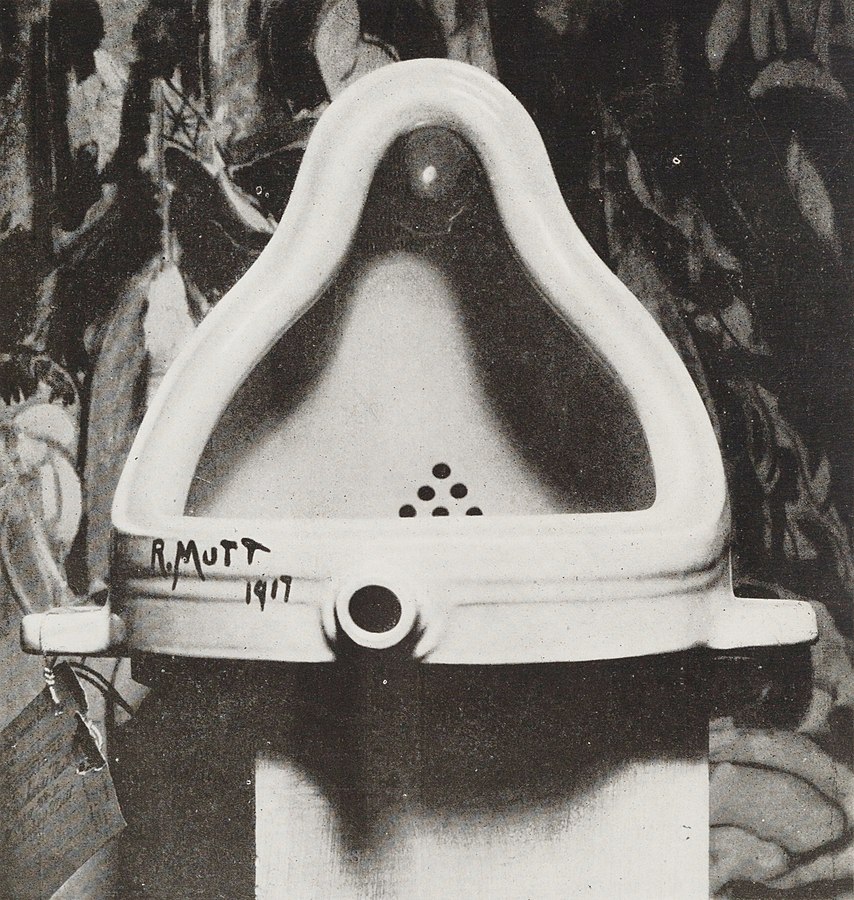
Marcel Duchamp, Fountaine, 1917, Wikimedia.com
Something happened a few days back that has caused me to continuously ponder on a particular issue relating to some fundamental issues about the field of art. If I could collapse this recent experience under any label that I would be free to choose, I would name it ‘thought-provoking’. So thought-provoking it was that I just have to write a post on this on the morning of a workday. Bear with me, and let me start from the beginning of how this reflective process came to be.
I recently had the great honour of meeting someone I consider a guru recently . This person possesses an impressive background in my field so much so that meeting this person stirred up a lot of feelings inside me. You know when you are about to turn in your homework to that teacher who has high expectations and you are exceedingly worried about what he or she says that you feel your stomach churn? That was literally how I felt. Anyway one thing led to another and before I knew it there I was seated face to face to this person. I can only say that meeting this impressive individual is not unlike when a rookie musician is being asked to bring their very weak demo to the likes of Madonna or Michael Jackson. You know your demo would never be good enough, you just hope the legend sitting in front of you could treat you with some kindness and refrain from laughing in your face. You reallllyyyyyyyy want to meet this big shot, so you don’t mind being laughed at or rejected as a tiny price to pay.
I am sure a musician would be able to identify with what I am saying. Showing your work involves a moment of great vulnerability. Doing so equates turning up naked for a first date or something like that. Call it a self-fulfilling prophecy or not, but I was indeed graciously rejected because I was told that I still needed to continue to ‘sharpen my saw.’ Walking away from this meeting, I really did feel quite forlorn. However, a stronger emotion started to build up internally over the course of the next day and that emotion was curiosity. The curiosity to know what ‘good enough’ looks like.
The following day, I reported back to my peers regarding how the meeting unfolded. One of them quipped that he really would like to see the works of this person too. Hence, I wasted no time and turned on my laptop to do a simple search with her name. Lo and behold, Uncle Google never fails to deliver. I found a piece of installation done from the very hands of the master. What was surprisingly not delivered however ,was the standard I was expecting from this master. The image that loaded on my screen was basically a collection of scraps ‘artfully arranged.’ Of course, there has always been the running joke of art being total junk yet selling for millions. As art teachers, we have basically seen everything and anything. we have learnt not to deride the most laughable examples through our daily interactions with the kids. We also are aware of that we should have a quiet dignity as artists and should be more open-minded and accepting of art that is not comprehensible by the average Jane. However, I am ashamed to report that we giggled like immature schoolchildren as we took in the image of the art piece. I guess this time, we failed to take the place of the ‘insider’, understanding this piece for it’s concept, meaning and intention. However in our defense, we were the audience and we had the license to react to it as authentically as we should. Today with a clearer and mature mind (and less propensity to chuckle), I am now writing this post to ask a serious question. When is it art and when is it considered nonsense? Does the answer ever shift and vary based on external factors?
Art has served so many purposes from religious, political to social means. With new ways to serve these purposes, art has lost it’s way in the world. It’s always there, surely. Perennial and evergreen. It will go strong. In what direction it goes, now that is anyone’s guess But it truly struggles to find it’s way, existing in flux from day to the next. A big cause for such instability since the modern era was the idea of ‘Art for Art’s Sake’. The notion that art is just created just for the sake of doing so, being completely futile in nature. So to be fair , I would like to bring in some points that I feel can highlight the utilitarian purposes of such meaningless seeming products.
Some features of such art:
1.To be aesthetically pleasing.
2.To make a point about something and then proceed to persuade or dissuade.
3.To provoke a reaction and open a discourse or debate. Let’s take a closer look at number. Provoke a reaction was indeed what Marcel Duchamp did when he submitted a urinal to the Society of Independent Artists’ salon in New York. Basically they accepted any submission as long as the fee was paid. He paid the fee along with the sanitary fixture complete with a signature ‘R.Mutt’ signed in black marker. One can already guess how the world reacted. I don’t need to elaborate too much as we already know this legendary story because Mr Duchamp changed the course of art forever by displaying that urinal on a plinth. Here I am writing about him in 2023. Every knows him. He started a debate which I can safely conclude has never been fully resolved until today. His action powerfully introduced the idea of the artist’s intention. His or her word is always law. The idea of ‘I say it’s art, therefore it is.’ of course this is a valid notion and a powerful one as it propagates meaningful making in art. But what about me as the viewer then? When I behold the artwork and I reject the notion that the urinal is indeed an artwork just because he says so… what happens then? How much power does he have as the creator, and how much power instead does the audience have? Is it 50/50? Is it a power struggle? Who wins? What about the background of the creator? Do things change if he or she happens to be a big shot? Yes, art is universal and transcends all boundaries. Everyone is born with the birthright to create Art. But does art become more of art if it were submitted by someone who ‘knows what he or she is talking about?’ If an artwork is proclaimed to be one although it looks like it was randomly gathered on the streets by someone of a certain artistic stature, does it become 100 percent art while if it was instead submitted by a ‘nobody’ in art and shifts the scale to 10% art and 90% nonsense instead?
There has been countless academic literature on the subject ever since Duchamp carried out his practical joke that turned out to be very practical after all in changing the discourse of Art. I just feel that the way we were were staring at the artwork by this person who has such an impressive background in our field with our mouths agape was just our way of accidentally partaking in the never ending discourse ‘Fountain’ a.k.a the urinal has triggered. I was told I was not good enough, yet that work was in such a league of its’ own. Not very much in a good way aesthetically from my perspective. It just goes to show that no matter how much experience one has in the field, art is impossible to fully comprehend. We couldn’t comprehend what we saw and reconcile it to what we know of the artist.
Art is truly sometimes contradictory, confounding, mysterious and impossible to overcome. It’s like the vast Agean Sea. So sublime and breathtaking, yet impossible to completely take in. But that’s really the beauty of it. At the end of the day, I am not providing the answer to these questions I posted here. I have no complete authority to declare if the work is nonsense or a genuine masterpiece. For me, the said work was not aesthetically pleasing nor did it display excellent technical skills. But it created an impact on me in a big way. What it did was motivate my colleagues and I to question some very fundamental ideas of art. It inspired me to write this post. By taking in the aesthetic value of the piece, my own perception of my own drawings (the ones I felt were not good enough) shifted dramatically. Above all, I was also was pushed out of my comfort zone and started to ponder more contemporary practices of art rather than the typical musings I make on the Renaissance or the Baroque. So if that particular piece of confounding artwork was meant to do a ‘Duchamp’, to provoke and to create a dialogue, I’d have to say it was truly a raving success.
Lest we forget, everyone recognises the disjointed Cubism of Picasso, while his mastery at realism (seen in his early attempt on the Belvedere Torso) has been forgotten instead for his signature abstract style instead. While one should never judge a book by its cover, one should not reduce the lifetime of one’s dedication to one mere piece of art. As he famously said, “It took me four years to paint like Raphael, but a lifetime to paint like a child.” I am not going to judge something I don’t fully understand, but a wise person should always start by asking useful questions. Never take anything at face value.
 writingaboutpaintings
Leave a comment