
Someone gave me a good piece of advice the other day and told me to look around me a little more because art is really everywhere. Ironically, that has always been what I aim to preach to the world. Hey, from time to time we need a friendly reminder from others right? It was then that I decided to pop by the National Gallery for a much overdue visit. I have to say that I was highly impressed with my experience as the museum was very different from what I remembered, and would be scheduling more visits on a more regular basis. So here I am, just writing about my overall impression of the place of interest. I hope this post serves you well.
Gorgeous Architecture
First off, let us take a moment to discuss the beautiful historical building this museum is housed in. The National Art Gallery of Singapore was the former Supreme Court/City Hall. With such an impressive setting, one can already guess that the collection found inside would carry no less weight than the building that contains it. With the largest collection of Singaporean and Southeast Asian Modern Art, it’s historically impressive venue complete with gorgeous rows of marbled columns and other fixture that echo it’s past as the headquartered seat of justice makes for a perfect experience.
Ticketing and Scale of Museum
Entry for Singaporeans is free, while General Admissions for non- locals go at $20 per individual. Singaporeans would need to fork out $15 should they want to visit special exhibitions, and it would cost $25 for foreigners. Doing the math, it would be much more value for money for our tourist friends reading this to purchase the All Access Pass at $30. A side note to my fellow Singaporeans, even though entry is gratis, one still needs to obtain the special sticker at the ticketing counter because they will certainly be asked for it by one of the museum personnel. I had mine in my pocket and was prompted to do so by one of the security staff.
Relative to the Louvre or the Prado, the National Gallery offers a more intimate setup , but I find the size of this museum to be already sizeable and would definitely requires a site map to navigate around. Just to reiterate, I do find gigantic museums to be somewhat overwhelming and consider the NG to be of the perfect scale. NG offers the free Gallery Explorer App which makes the experience seamless through the app with features such as booking of tickets as well as using it as a guide/audioguide. I personally would give 10/10 for this app for the nifty tool features content in the four official languages of Singapore. To know more about an artwork, just scan the barcodes next to the works and listen to the audioguide by placing the phone on the ear (no earpiece required).
Viewers can also choose to either read the description of the painting or to hear the audioguide. It is also possible to alternatively search for artworks on the app interface instead of scanning barcodes. I for one, detest the latter with a passion, so I really prefer doing a good old search on the clean interface of the application. I have been to museums and have had to pay a fortune for the audioguide which subsequently turned out to be underwhelming or not working. My experience at the Istanbul Archeological Museum turned out to be just that. Even worst, I had to let them hold my passport as a form of collateral. So kudos to the National Gallery for this nice touch.
Audience
As someone who last stepped into this museum for the very first time after a long hiatus (my last visit was a school trip to bring my students to view the fantastic Impressionism exhibition at this museum), I had very little recollection of what to expect. Bear in mind that I was not there to view the permanent collection the last time I was here. So this trip was as good as my first experience with the National Gallery.
The story of Art presented here is one deeply entrenched in Singaporean history and culture. Snippets of national history as well as the evolvement of the arts scene were presented in a chronologically logical order through meticulous curatorial planning. I feel that even if one is not interested in Art, a visit to this attraction would also give one clear insights into the general culture and history of Singapore through the unique lens of the visual arts. Furthermore, the clear descriptions that outlined each section were succinct and presented a clear overview of the body of works it encapsulated making the viewing experience a pleasure.
Even if one doesn’t already need the introduction to the Singaporean identity, it is also quite a nice experience watching how local artists express themselves and reframed ideas through various artistic mediums as a reaction to happenings on our land. Furthermore, the Southeast Asian collection Between Declarations and Dreams: Art of Southeast Asia Since the 19th Century offers a solid oeuvre of regional artists that ‘negotiated the meaning of art and sought to reinvent vernacular expressions and aesthetics.’
As another ‘topping on the cake’, there are always temporary exhibitions at NG that frequently get updated, meaning that fresh collections arrive every couple of months. Open for viewing now is The Neglected Dimension features art from the 1960s onwards when abstraction and calligraphy were main expressions of Islamic Art in Indonesia. The artworks were very colourful and visually appealing in my opinion and definitely worth a visit. There is also an upcoming show entitled Tropical: Stories from Southeast Asia and Latin America that will commence from 18th November 2023.
Some of the notable works that caught my eye :
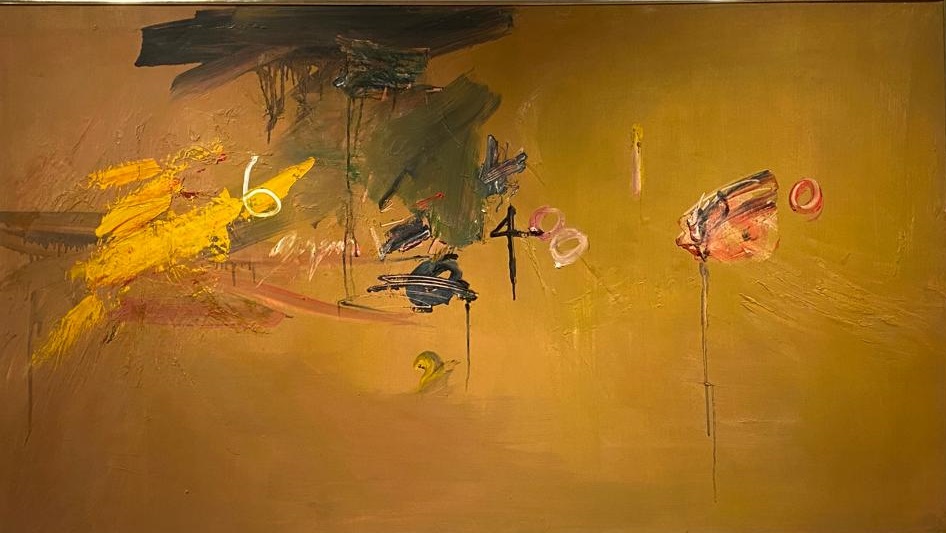
This was the first piece that greeted me as I entered the musuem space due to the strong play on abstraction and bold colours. This work was a part of a series inspired by the artist who found a wall graffiti at her neighbourhood void deck. For Suzann Victor, this graffiti displayed a tension between rote pedagogy and self expression, which also emphasised the Singaporean preoccupation with values and figures.
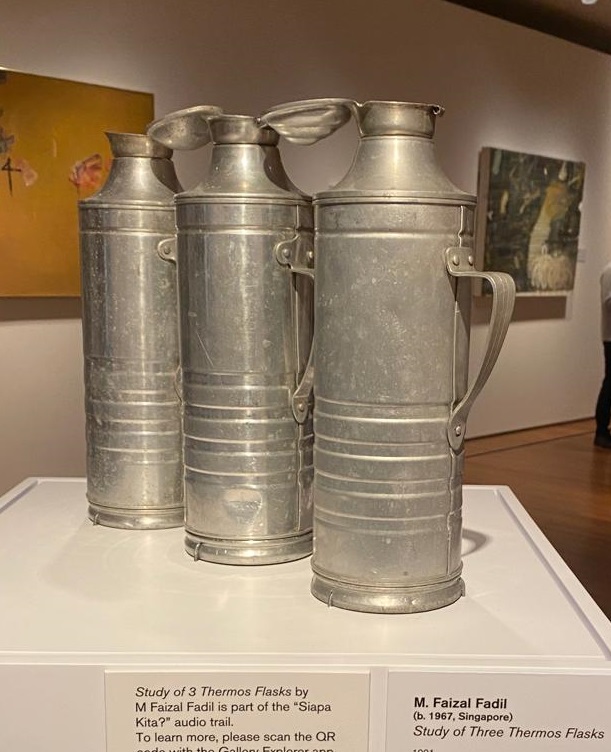
This installation features three metal flasks purchased from ”Thieves Market”, a highly popular flea market located at Sugei Buloh. The academic name ‘ Study of Three Thermos Flasks’ highly contradict the appearance of the imperfect quality of the objects. This particular piece was a response from the artist to Duchamp’s ready-made art at a time when questions about the idea of ready-mades were pervasive in the Singaporean art scene.
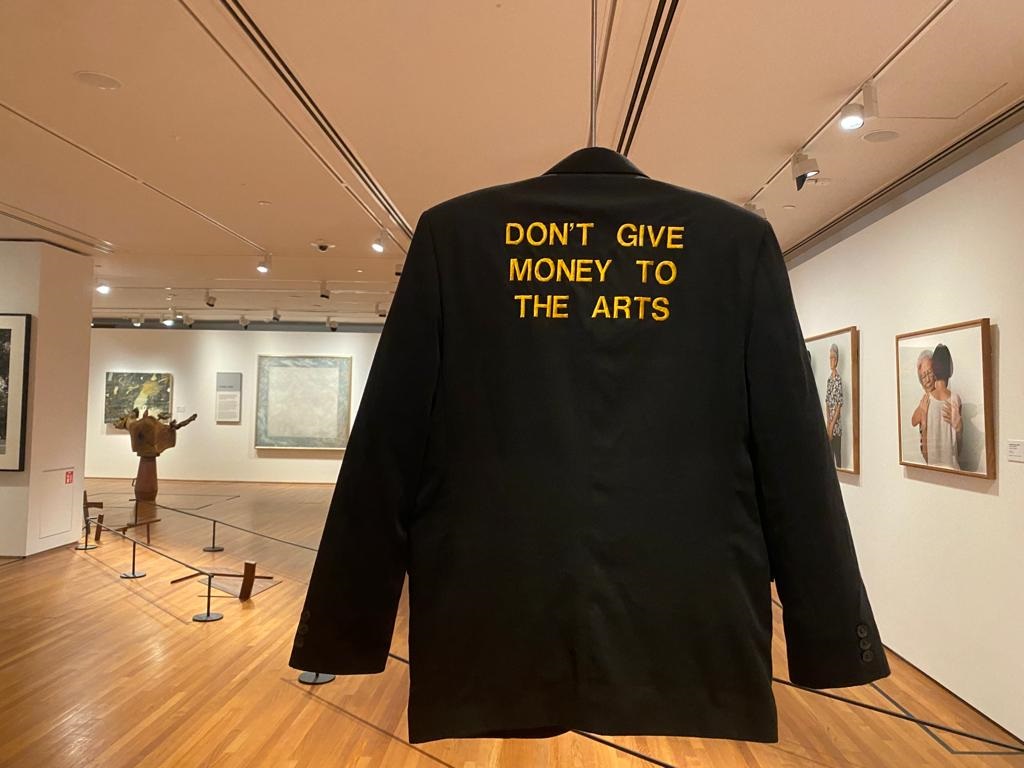
A prized artefact from a performance by Tang Dawu, the artist sought the permission of the then president to don this jacket and subsequently gave the head of state a lettter which said ‘ I am an artist. I am important.’ Regarded as one of Tang’s most prominent works , he was confronting the issues of art practice in Singapore.
As impressive the offerings from this museum are, I still personally felt that the backbone of the entire collection rested on the pioneer Nanyang artists such as Liu Kang , Chen Wen Hsi, Georgette Chen and other prominent pioneer Singapore artists who were the frontrunners of the Nanyang style of painting. I would say that these artists were the true stars of the show for they were really the first authors to write the story of Singaporean Art.
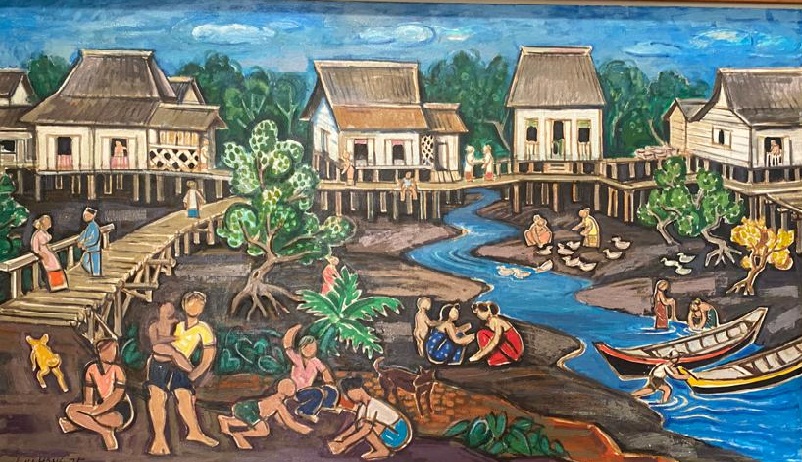
This image portrays the image of a village near the Pasir Panjang district in the 1970s .This piece of work shows off the artist’s great skills at composing a dynamic layout that leads the eye in an interactive fashion. As a person who highly prize composition on a piece of work, I was particularly taken by this work.
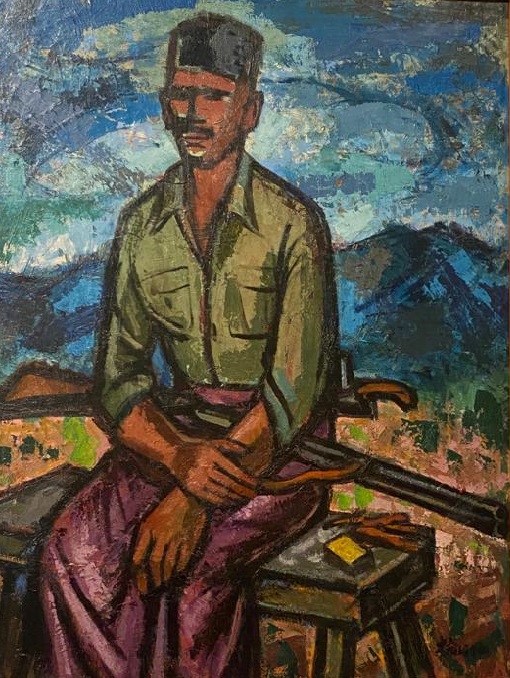
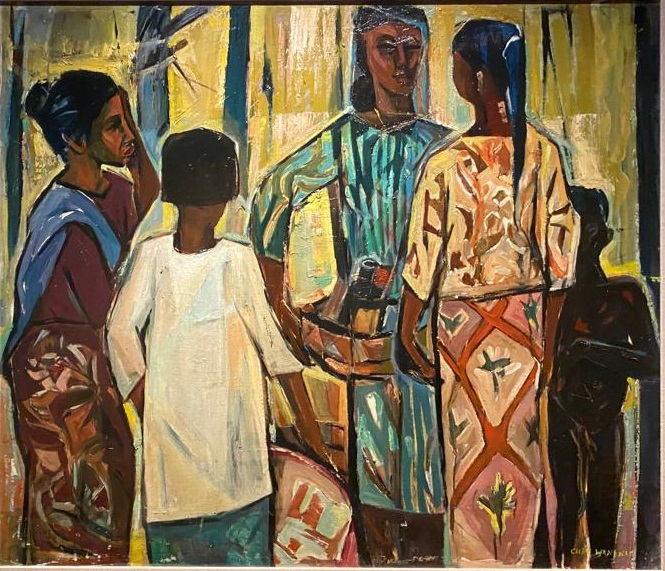
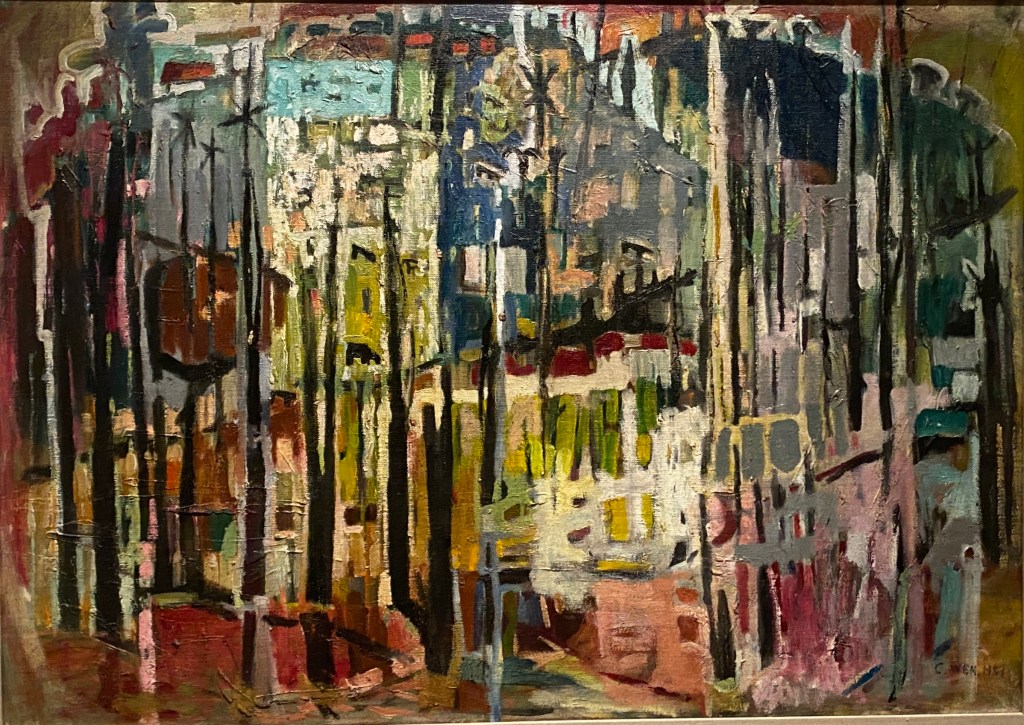
The artwork Returning from the Market displays a culturally typical scene from the ethnically diverse Singapore. The avant-garde painter Chen Wen Hsi employs strong linework and colour in blocks to render a group of people in traditional garb. Although he renders in simple semi-abstract forms, Chen records the different patterns, textures on these figures with attention to detail.
This work demonstrates Chen’s inclination to experimention with various techniques in developing a unique style. Influenced by Cubism, he frequently reduces three-dimensional forms into flat planes. Also heavily influenced by Fauvism, he utilises non-naturalistic to convey emotions and create visual harmony. His oil on board entitled Seaside displays his inclination to abstraction and his avant-garde impulses to a greater degree.

The legendary Georgette Chen used a myriad of different hues with an interestingly green undertone to create the luminosity of her face and to enhance her warm skin on this self-portrait. She rendered in lines sparingly to depict features to depict the facial contours and hair, and employs the modest use of colour in a similar fashion in sectioning out facial complexion tones from the neutrality of the background.
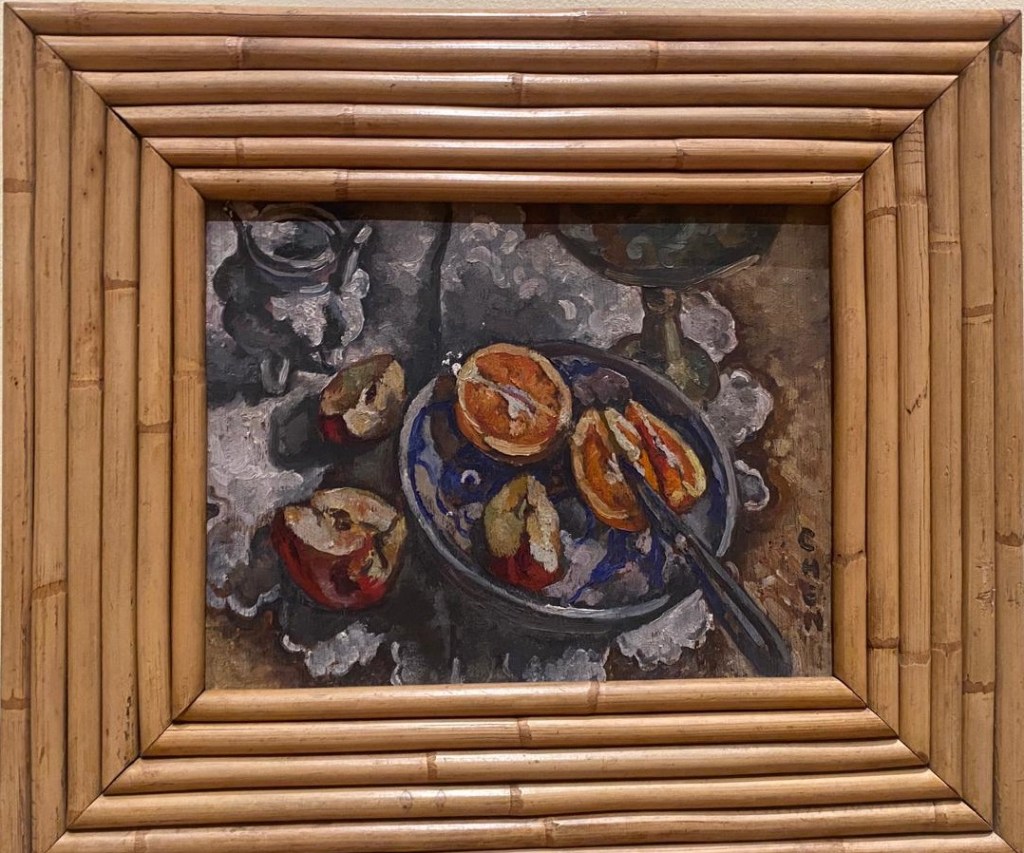
One of the artist’s earlier works, this painting displays the heavy influence of Paul Cezanne. The lively treatment from the brushstrokes paired with intense and heavy tones give a certain heftiness and corporeality to the fruits. Her subject matter was also elaborated through a clean and compact layout, giving immediacy and tangibility to the still-life, a quality which is rampant in Chen’s paintings.
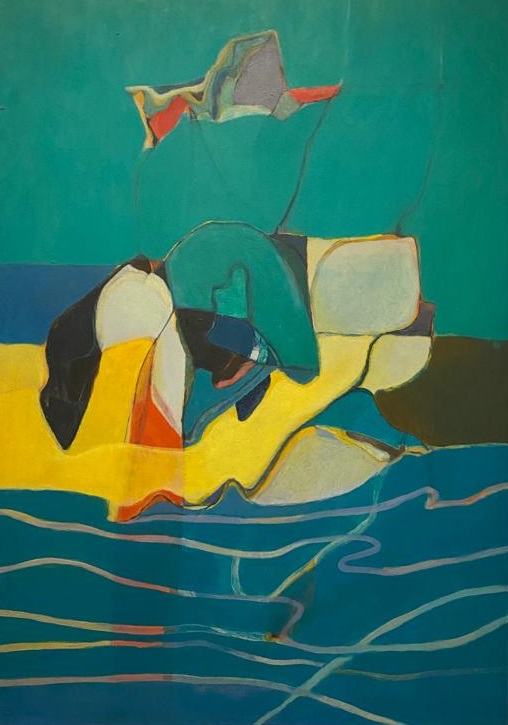
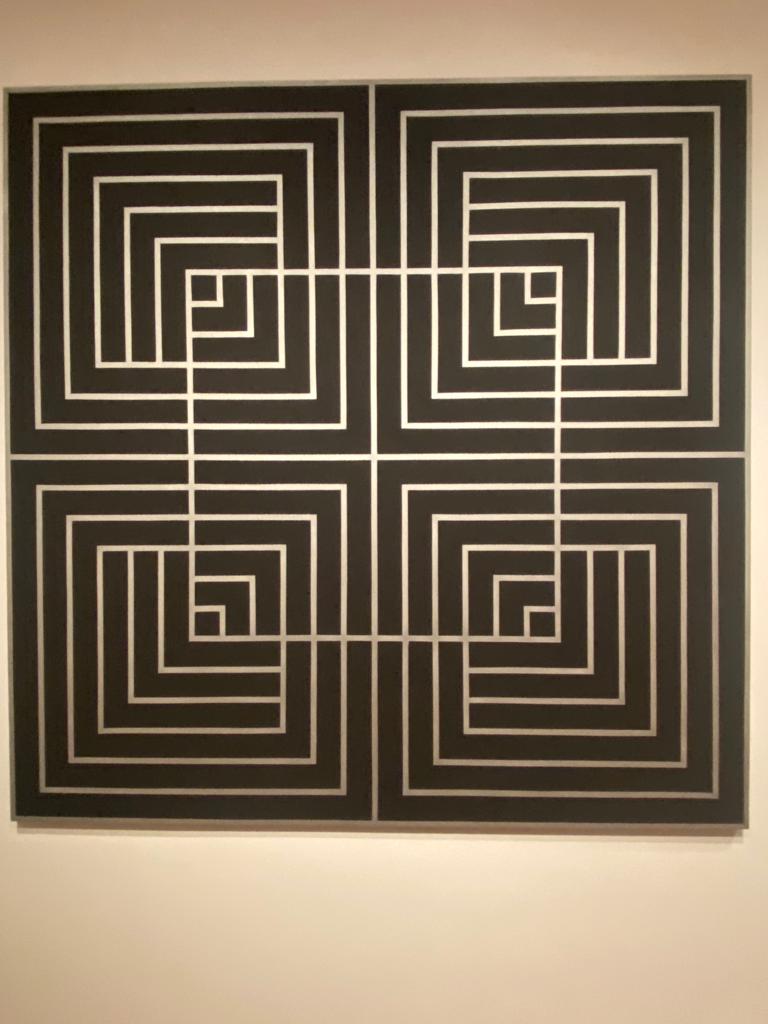
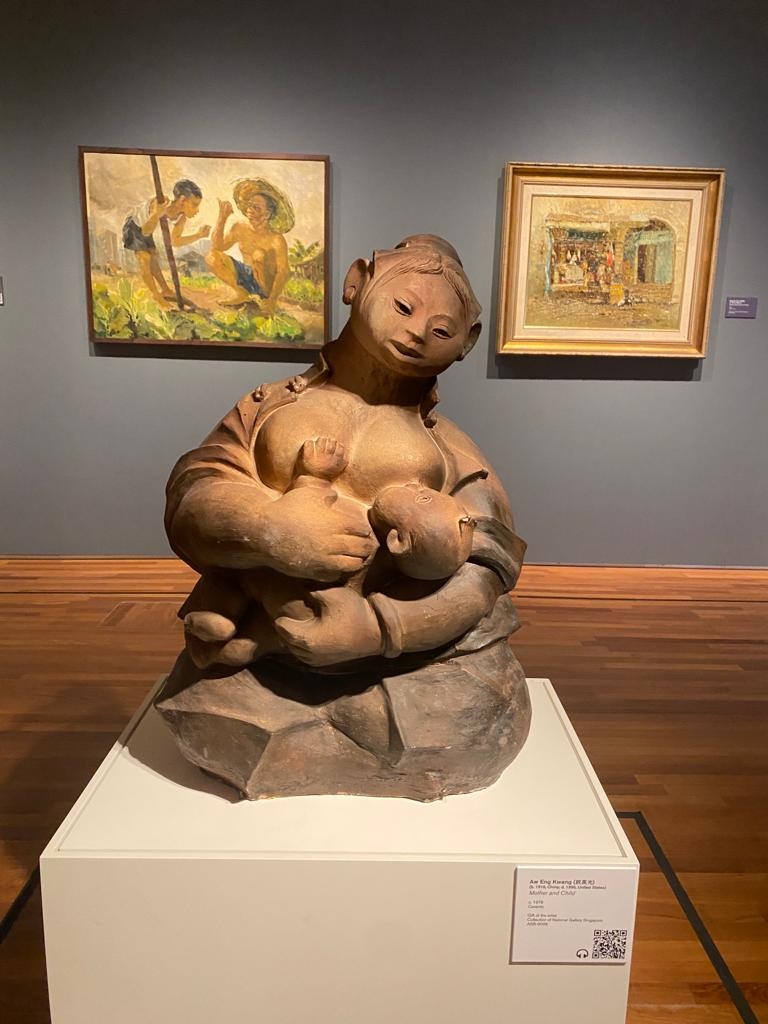
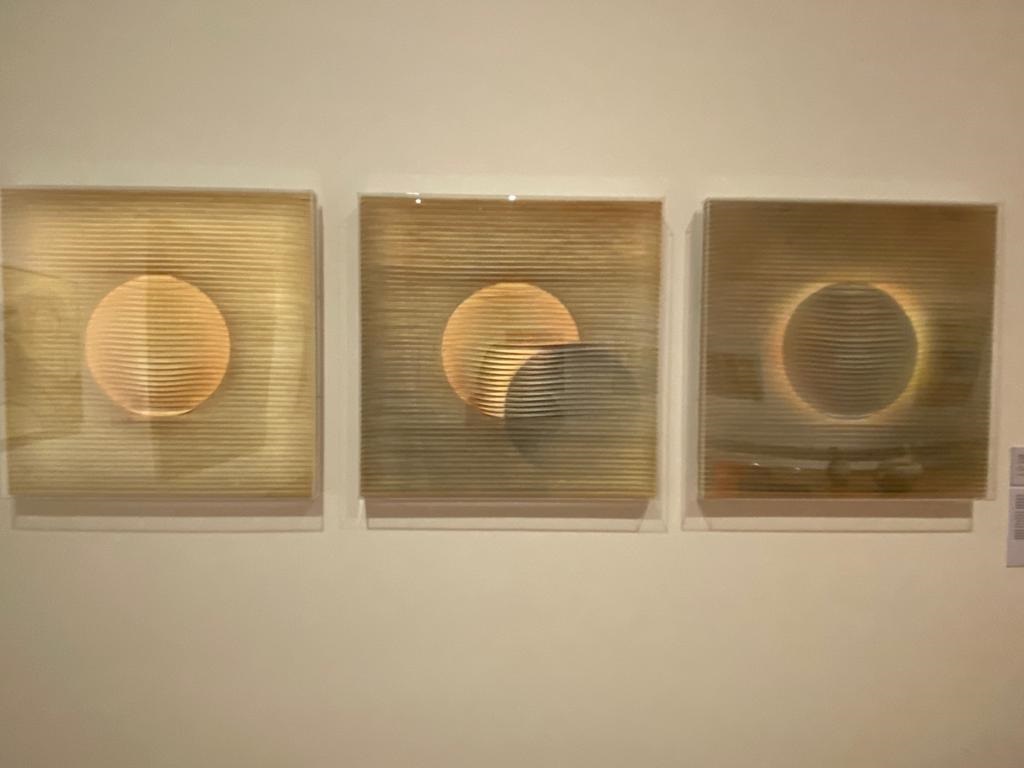
Experimenting with Abstraction and Medium.
Evidently seen in the Western influences of the pioneer artists, although mostly local subject matter and themes were being explored, one cannot forget that Singapore was very much influenced by the West and we were seeking new ways to marry our unique self-identity with these outside trends. Mediums were continually being explored in highly creative and unconventional ways. As Modern Art progressed from the Seventies onwards, physicality was always something that preoccupied the minds of Singaporean artists as they started to embrace textural properties on two-dimensional surfaces such as the canvas. Equally important for artists was how to reinterpret traditional art forms such as ink and batik and how to make them relevant in changing times.
Other Prominent SEA Artists
As mentioned at the beginning of this post, Between Declarations and Dreams; Art of Southeast Asia since the 19th Century offers a terrific insight into Southeast Asian artistic identity that has emerged and evolved in reaction to the social and political climate since the 19th century.
I was very much taken by this series by Juan Luna entitled Spain and the Philippines (1884 and 1888-93) in this allegorical artwork. For some reason, they reminds me very much of the work of Sir Lawrence Alma Tadema.
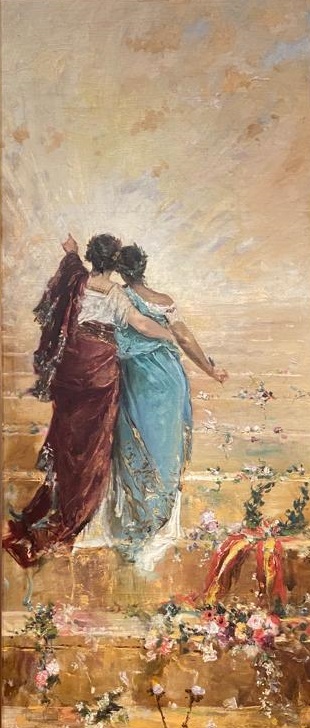
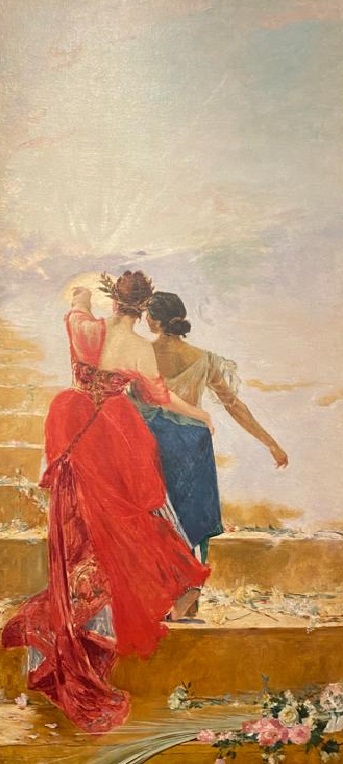
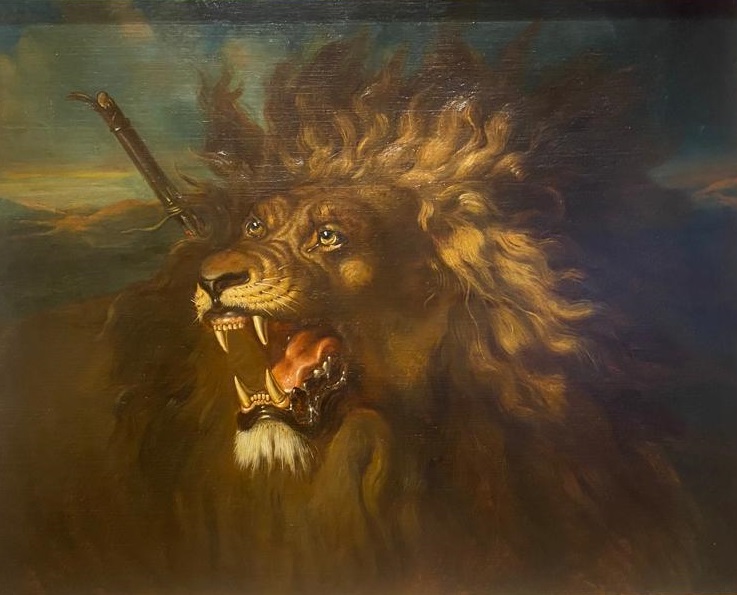
Raden Saleh was also featured heavily in this section. the Indonesian Romantic painter truly stole the limelight in this particular section of the museum. The painter studied wildlife such as lions and tigers in emotionally-charged scenes. So emotionally charged that they have the frequent effect of stopping visitors in their tracks for a closer look.
Rest and Relax.
The Courtyard Cafe and Lounge is located at the other side of the building at the basement (one needs to take the escalator down) and offers a nice and quiet sanctuary for the tired. The offerings are reasonably priced and mostly local dishes and beverages are served here. For something more upscale, visit the rooftop bar Smoke and Mirrors offers a gorgeous view of the skyline and offers up concoctions that artfully mimic the artistic vibe of the building.
The beautiful view of the Marina Bay Sands hotel can be enjoyed at the bar’s terrace, or even upon exit from the museum as the iconic hotel is located right opposite the museum from a distance. Let’s just say that view makes for a perfect grand finale from the National Gallery. A landscape so beautiful, it can be considered a masterpiece in itself.
Disclaimer: Some of the content written pertaining to some of the paintings here were based on resource found on the museum’s label and National Gallery Explorer app.
 writingaboutpaintings
Leave a comment