The Ancient Egyptian pantheon included hundreds of deities, though a core group of about twelve held the greatest significance for the people. In a land teeming with dangerous animals—from crocodiles lurking in the Nile to lions roaming the desert—these natural threats were a constant source of anxiety. Yet, rather than trying to eliminate them, the Egyptians took a more spiritual approach.
As the saying goes: “Keep your friends close, but your enemies closer.” The Egyptians transformed these fierce creatures into protective gods, believing their powerful traits could be harnessed to guard and guide them in life, death, and the afterlife.
Sobek: The Crocodile God of the Nile
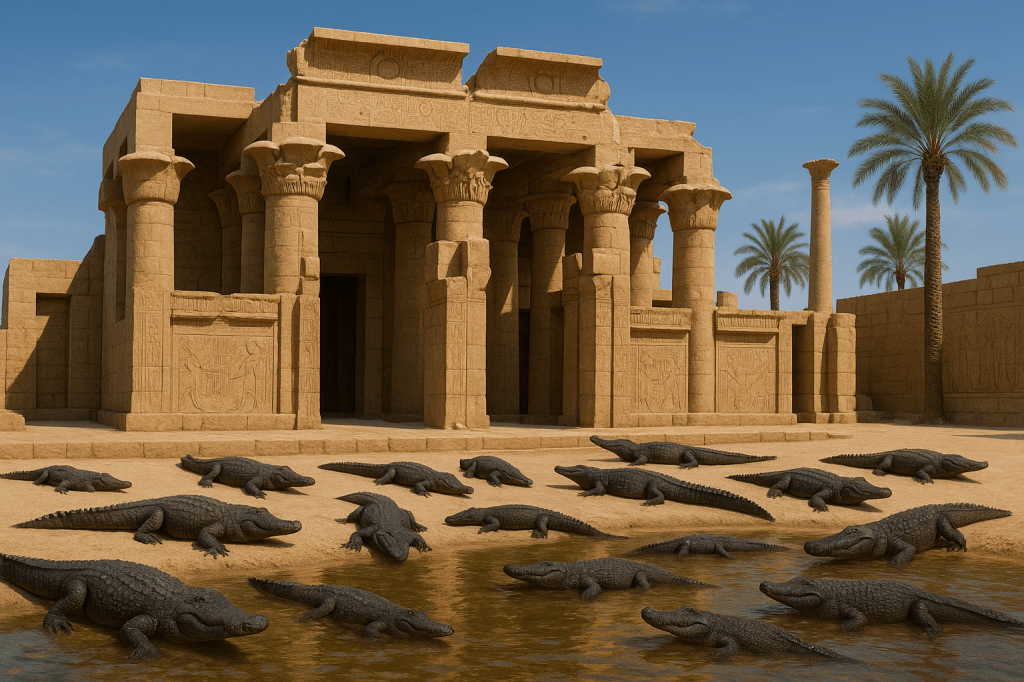
This deity’s name is associated with impregnation and virility, making him the patron god of fertility. Due to his crocodilian traits, he was also naturally connected deeply to the river Nile which was central to Egyptians and was considered a life-force both literally and metaphorically. Hence, Sobek was regarded unanimously as the protector of the great river as well as the Pharoah himself. The reptilian deity was also dualistic in nature. While being predatory and sly, he could also be nurturing and protective, embodying all key characteristics of the river-dwelling beasts. Being able to control the river cycle and floodwaters, Sobek was key to agricultural prosperity as it was deeply dependant on several aspects of the River Nile. Sobek was also sought for blessings in health and well-being and was equally also important in the afterlife where he led Pharaohs to cross over to the divine realm safely. 1
A notable place of worship to the crocodile god is the Temple of Kom Ombo, where there was a dual dedication to both Horus the falcon-headed god, as well as our deity in question, Sobek. This sancturary was home to Sobek’s principal cult, located in a region once overrun by crocodiles. Until relatively recent times, the Nile swarmed with these fearsome creatures, which would bask along the riverbanks and prey on both animals and humans—naturally inspiring fear among the local population.However, the people believed that by revering the crocodile as a totem animal and sacred being, they could avoid its wrath. Crocodiles were even kept alive within the temple precincts, and numerous mummified specimens have been discovered in nearby cemeteries—some of which remain on display in the temple sanctuary to this day.2
Sekhmet: The Lioness of Fire and Fury
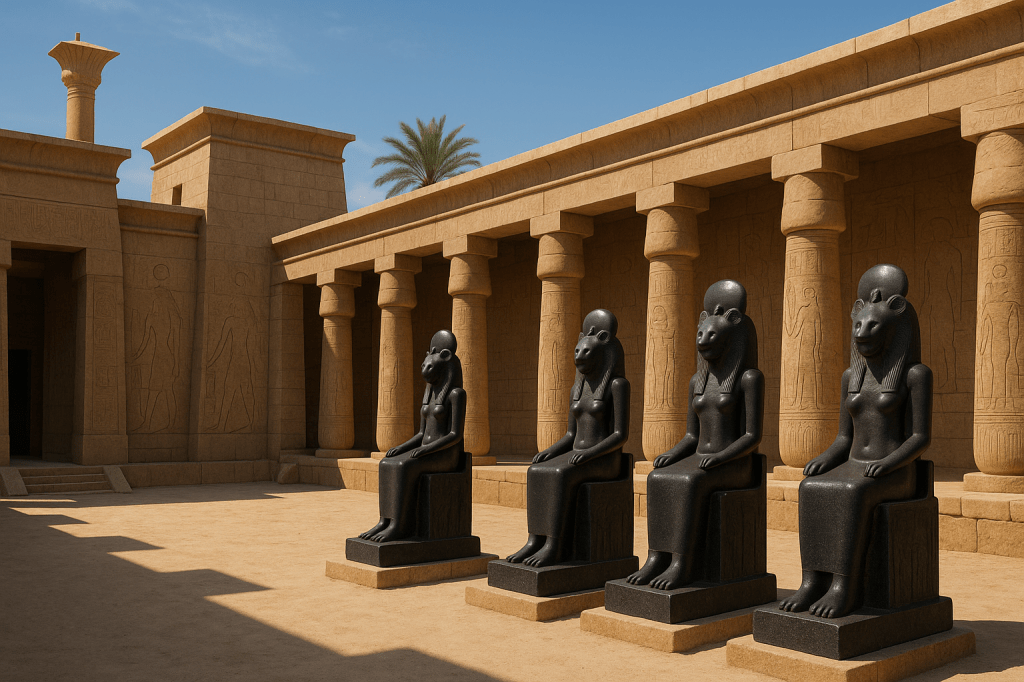
Sekhmet, whose name means “She Who Is Powerful” or “The One Who Loves Ma’at,” was the goddess of the hot desert sun, plague, war, chaos, and also healing. Born from the eye of Ra as an instrument of vengeance, Sekhmet was known as the “Mistress of Dread.” She could bring destruction—but also on the flip side, restoration. Depicted as a woman with the head of a lioness and crowned with the solar disk, Sekhmet embodied raw, untamed power. Yet when appeased, her fury softened into her gentler form, Bastet, the domestic cat goddess of home and joy. Sekhmet’s duality (as already seen with Sobek) reminded Egyptians of the fine line between destruction and protection.3
One of the most famous myths surrounding this goddess explains how she was pacified during a moment of devastating wrath. According to legend, after being sent by Ra to punish humanity for their rebellion, Sekhmet unleashed a bloody rampage, slaughtering countless people. Fearing total annihilation, the gods concocted a plan to save humanity: they brewed vast quantities of beer and dyed it a deep red to resemble blood. When Sekhmet saw this “blood,” she drank it eagerly, becoming intoxicated and losing her violent rage. Drunk and pacified, Sekhmet’s destructive fury subsided, allowing life and order to be restored. This event was commemorated in the annual “Feast of Drunkenness,” during which Egyptians celebrated Sekhmet’s mercy and the balance between destruction and healing she embodied.Sekhmet was worshipped in the Temple of Mut as a powerful aspect of the goddess. Many black granite statues of her were placed here—some still survive today.
Wadjet: The Cobra Goddess of Lower Egypt
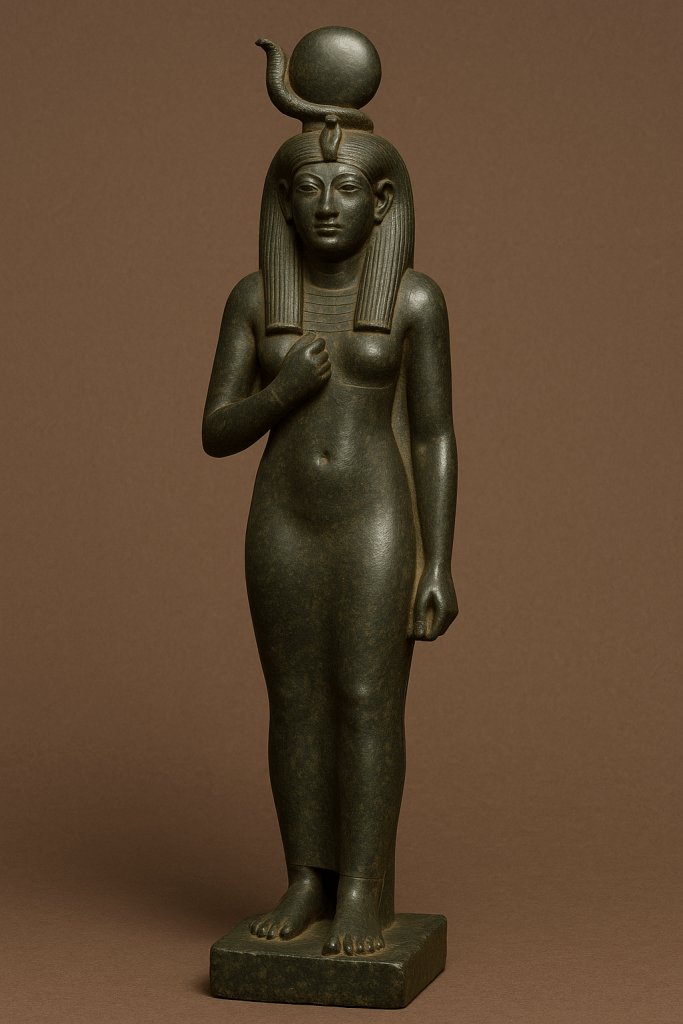
Wadjet, one of the oldest goddesses in the Egyptian pantheon, was often portrayed as a rearing cobra, a winged serpent, or a woman with a cobra’s head. She was the protector of Lower Egypt and a powerful symbol of kingship and divine authority. Her name Wadjet means “Green One” or “The Green One.” This name likely refers to the green color of the papyrus plant or the lush marshlands of the Nile Delta, which she created herself. Wadjet was also closely linked to the “Eye of Ra” or ”Eye of Horus”, a powerful protective force. The green eye symbol (sometimes also significantly called the “Wadjet Eye”) became associated with healing, protection, and royal power especially when associated to the Eye of Ra. Wadjet also embodied maternal instinct and played a nurturing role in raising Horus, the son of Osiris and Isis (Aset), and was revered as “Great of Magic.” Wadjet offered protection from demons, bad luck, and spirits, and was also called upon during childbirth and to guard newborns.4.
Wadjet later evolved into a powerful national symbol of protection and kingship. As the guardian of the land and the pharaoh, she was frequently depicted in temple carvings, sometimes shown spitting fire at enemies to ward off chaos. Her most prominent cult center was at Per-Wadjet (known to the Greeks as Buto), although she was not as widely worshipped in large state temples like those of Amun or Osiris. Nevertheless, her presence was deeply woven into the fabric of royal iconography. She appeared alongside her southern counterpart, Nekhbet, as one of the “Two Ladies” in the pharaoh’s titulary, symbolizing the unification of Upper and Lower Egypt and affirming her lasting ritual and political significance.
Anubis: Guardian of the Dead
Almost a household name in Egyptian mythology which denotes “To decay” or “He who is in the place of embalming. With his sleek black jackal head and solemn gaze, Anubis was the god of embalming, funerary rites, and the protection of graves. Jackals used to roam the necropolises of Egypt, and the link between these scavengers and the afterlife was clear. Thus, Anubis emerged as the divine guardian of tombs and the inventor of mummification.
Though associated with death, Anubis was not feared as an evil force. Instead, he was a benevolent guide who ensured safe passage to the afterlife. His black coloring symbolised both the fertile Nile soil and the rebirth it promised, reinforcing his role in resurrection and eternal life. While there is no known temple dedicated solely to Anubis, he is widely featured in shrines to other deities, tombs as well as funerary rituals.

Conclusion: Divine Danger as Protection
The gods of ancient Egypt were not passive or purely kind. They reflected the natural world in all its power, danger, and unpredictability. By deifying the fiercest creatures they knew, the Egyptians sought to harness their energy and transform fear into strength. These dangerous gods—whether crocodile, lion, cobra, or jackal—were not just forces to be feared, but guardians to be worshipped. In their danger lay their power, and in their power lay protection.
 writingaboutpaintings
Leave a comment