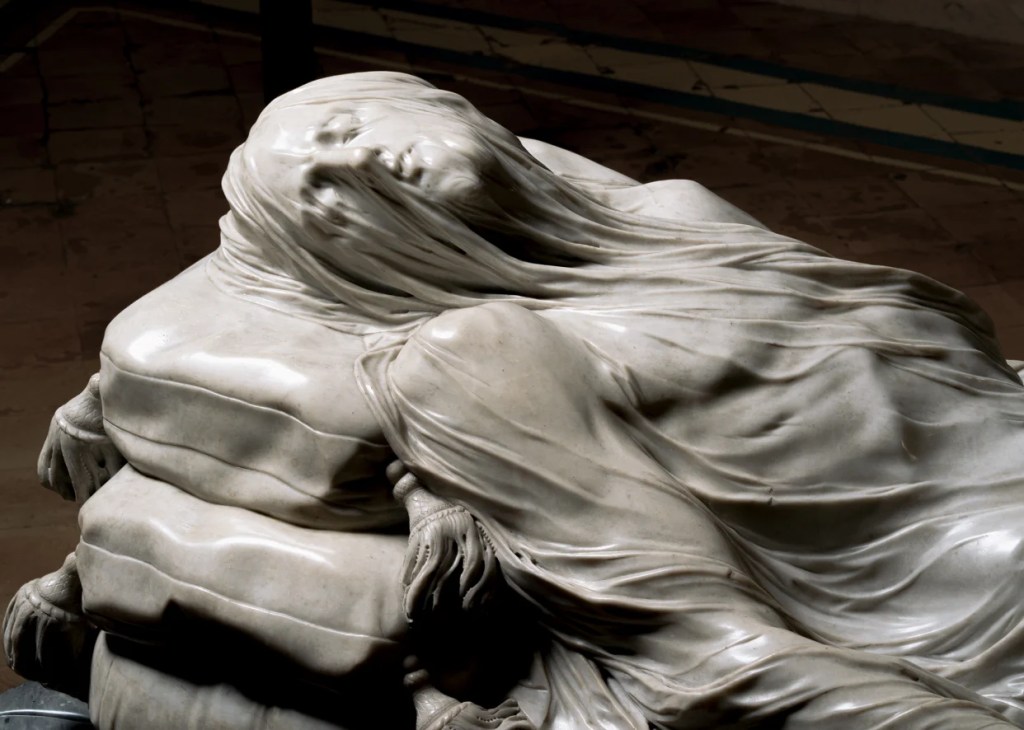
If you’ve ever stepped into the Sansevero Chapel in Naples and laid eyes upon Il Cristo Velato—The Veiled Christ—you’ll know this is not merely a sculpture. It is an encounter. What first captures your eye is the architectural setting itself: a space charged with symbolism, where other impressive works seem to bow in reverence, framing the transcendent centrepiece immortalised in gleaming stone. This arresting sculpture took shape under the hands of the young Neapolitan artist Giuseppe Sanmartino and was completed in 1753 where it was not an immediate marvel, but saw its reputation grow increasingly with the gradual passing of time.
The origins of Il Cristo Velato itself came from a place of mystery and wonder. Commissioned by Raimondo di Sangro, a nobleman, alchemist, and Freemason, the seventh Prince of Sansevero remains shrouded in mystery—a man obsessed with forbidden knowledge and the mystical sciences. The chapel of Sansevero that he envisioned was not merely religious. It was also conceived as a temple of the soul: a space where stone would speak of birth, death, and transcendence.
It has long been whispered throughout eighteen-century Neapolitan alleyways that Raimondo used secret alchemical techniques to “marmorize” a real cloth—transmuting fabric into marble. Whether true or not, this myth embodies alchemy’s greatest dream: to master the hidden laws of nature, to make the impossible visible. And that is what Cristo Velato does. It is not merely a representation of mourning—it is transmutation. Christ, veiled and still, lies not in defeat, but in a sacred pause between worlds. It is the moment before resurrection, the still point before transformation. Alchemy or not, it is irrefutable that under the hands of Sanmartino, he brandished his chisel as if with some sort of enchanted magical wand where an unthinkable icon of beauty was born that surpassed the very boundaries of art.
The sculpture stands firmly within an artistic traditional obsession that stretches back to antiquity. It has long been the ambition of Greek and Roman sculptors to breathe life into marble—to make hard stone fall, fold, and flow like fabric. My personal favourite, the Hellenistic Nike of Samothrace which can now be found in the Louvre, captures that very ambition in powerful windswept robes of the Victory Goddess frozen in mid-flight. But Il Cristo Velato goes further. It doesn’t just echo such classical ideals—it surpasses them. There is a touch of translucency in the fabric that shrouds the beautiful body of Christ, where traces of the veil enhances and not covers the countenance of Christ as his wounds, well as the slight rise of His chest. Even Antonio Canova, the most renowned sculptor of his age and a master of marble himself, was said to be so moved by the Cristo Velato that he declared he would have given years of his life to have been its creator. Such a compliment is no small feat, especially coming from a man who defined sculptural perfection in his time. For Giuseppe Sanmartino, the young artist behind this miracle in stone, it was immortal recognition.
As Michelangelo once said:
“The sculpture is already complete within the marble block, before I start my work. It is already there, I just have to chisel away the superfluous material.”
In Sanmartino’s Cristo Velato, this feels literal. It is as though the image of Christ was not sculpted, but revealed—drawn out of the stone like a divine secret waiting to be uncovered.
Where classical sculptures often celebrated movement, fabric, and the idealised human form, Cristo Velato goes beyond illusion. It captures the breath of stillness, the fragility of transformation, and the softness of the eternal, all inside the cold permanence of stone.
Il Cristo Velato is, without question, one of the most exceptional masterpieces in the history of art. It is a testament to transformation—of Christ, of matter, of what art can be. It challenges the limitations of grief and materiality and dares to suggest that new life can follow death, that softness can be born from stone, and that the soul can be touched through form. Whether you are a believer, a skeptic, or simply a lover of beauty, the sculpture whispers that there is more beyond the visible, and that art, like alchemy, has the power to awaken the soul.
To witness it is to understand that beauty, when it approaches the sacred, no longer belongs only to time—but to eternity. It is for sure that even after centuries from now, Il Cristo Velato would continue to astound future generations as if untainted by time. Here in the Cappella Sansevero, time dissolves, logic falters, and only beauty and the weight of experience endure.
 writingaboutpaintings
Leave a comment