Arriving at the Valley of the Temples, the first thing I noticed wasn’t the ancient ruins. It wasn’t the landscape, the weathered stone, or the ochre dust suspended in the late afternoon light. It was our guide, Giovanna, who greeted us with a warmth and spark that mirrored the burning sun overhead.
Her voice carried both knowledge and warmth as she welcomed us to the renowned Valley — which, she mentioned in passing, had been her playground since childhood, as if it were no big deal. That little revelation told me that this sprightly lady held the keys to every hidden corner and secret of the place — and that we were in for more than just a run-of-the-mill tour.
Spoiler alert: I wasn’t disappointed.
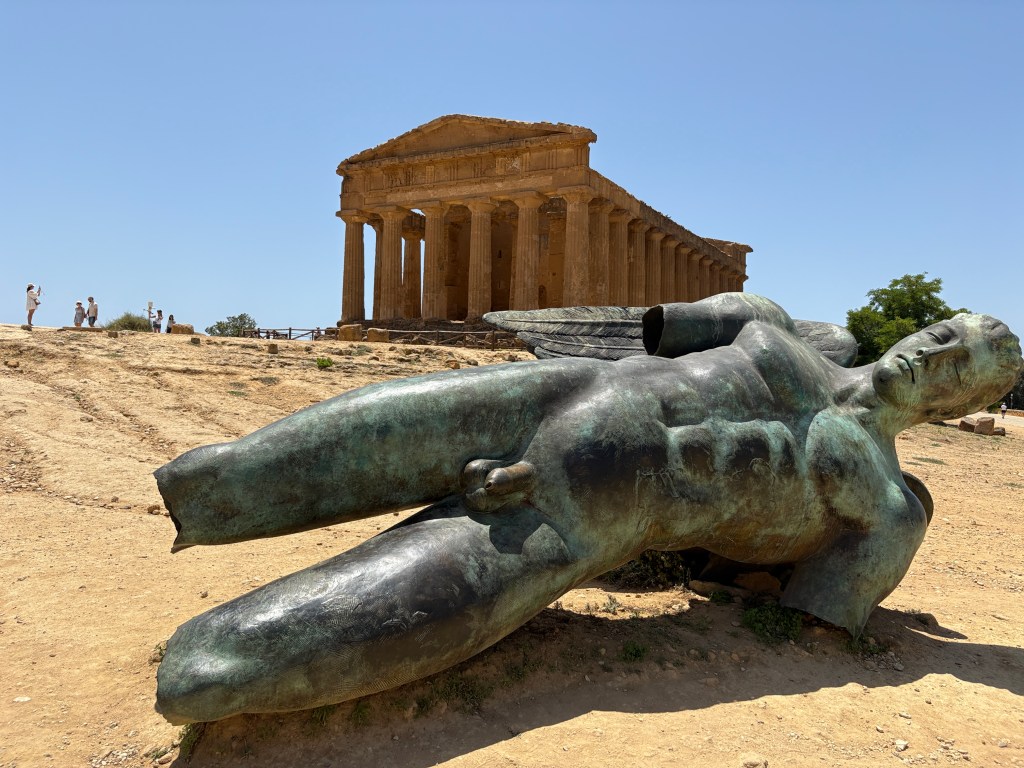
I had come here with no expectations — no deep dive, no curated list of “must-sees,” no mental slideshow of what was to come. Just a vague image I’d seen before: that iconic shot of the Temple of Concordia rising behind the reclining bronze sculpture of a fallen man. A scene that felt too polished, almost unreal.
The grandeur wasn’t in the postcard moment — it was in everything else: the uneven paths, the scent of dry grass and stone, the way the light grazed the columns with the patience of centuries. Concordia didn’t shout its presence. It waited — and when I finally reached it, the temple felt at once impossibly solid and startlingly gentle. Like something that belonged to the earth, not separate from it.
The names we use for the temples today — like Concordia, Hera, and Heracles — weren’t necessarily their original ones. In fact, these titles were often chosen not because we know exactly which deity the temple honored, but because the names sounded… well, more noble. More poetic. It was the Italian archaeologists, Giovanna explained with a knowing grin, who gave the ruins such romantic titles. The Germans, ever pragmatic, had simply labeled them Temples A through F.
There was something both charming and revealing in that contrast. A temple can be a ruin, a letter, a goddess — depending on who’s looking. History isn’t always what’s written in stone. Sometimes, it’s what we decide to name the stone in order to make it mean something.
Walking the ridge, two temples stood out above the rest: the Temples of Concordia and Juno. Concordia is often called the jewel of the Valley — and for good reason. It is one of the best-preserved Greek temples in the world, its columns and inner chamber remarkably intact. This preservation owes much to its transformation into a Christian church in the 6th century CE, which spared it from destruction. Standing before Concordia, I felt the perfect symmetry and classical beauty that generations have admired — a quiet testament to human artistry that has endured millennia.
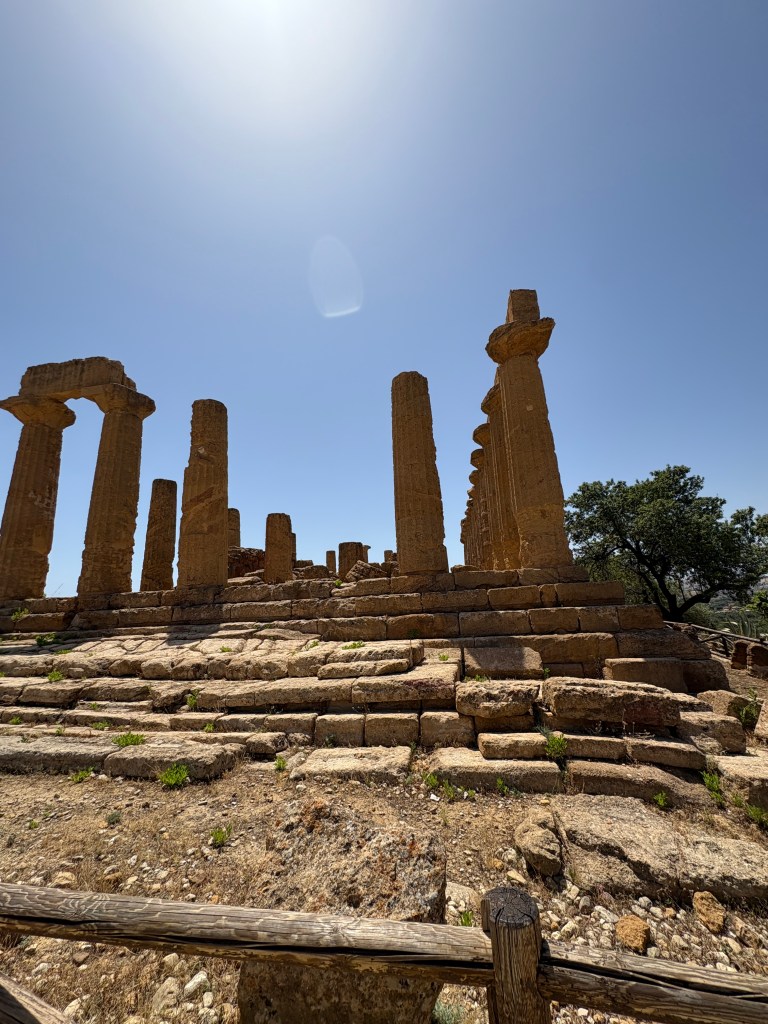
Further along, the Temple of Juno holds a different kind of allure. Though partially ruined, its position offers sweeping views of the valley and the sea beyond. Its stones bear scars — evidence of fire and invasion — giving it a romantic, heroic air. It’s a temple that tells a story of endurance, not just in its structure, but in its presence. Though the true deity it once honored remains uncertain, the name Juno (or Hera) has stuck — adding a layer of myth and mystery.
What also struck me — something Giovanna mentioned almost in passing, but that stayed with me — was that Sicily was once wealthier than Greece itself. The Valley wasn’t just a provincial outpost. This was part of Magna Graecia — “Greater Greece” — the term the Romans later used to describe the flourishing Greek colonies across southern Italy and Sicily. These cities weren’t on the margins of the ancient world; they were its beating heart.
Akragas, with its wealth, ambition, and astonishing architecture, was a wonder even to the Greeks. Standing there, it was impossible not to feel the echoes of that confidence — the boldness it must have taken to carve such beauty into stone, to imagine that it would last forever.
It’s humbling to stand there, centuries later, knowing that what we now consider a “ruin” was once a statement of brilliance. And more than that — that this brilliance didn’t come from the usual centers of history we’re taught to revere, but from the rugged, sunbaked island of Sicily.
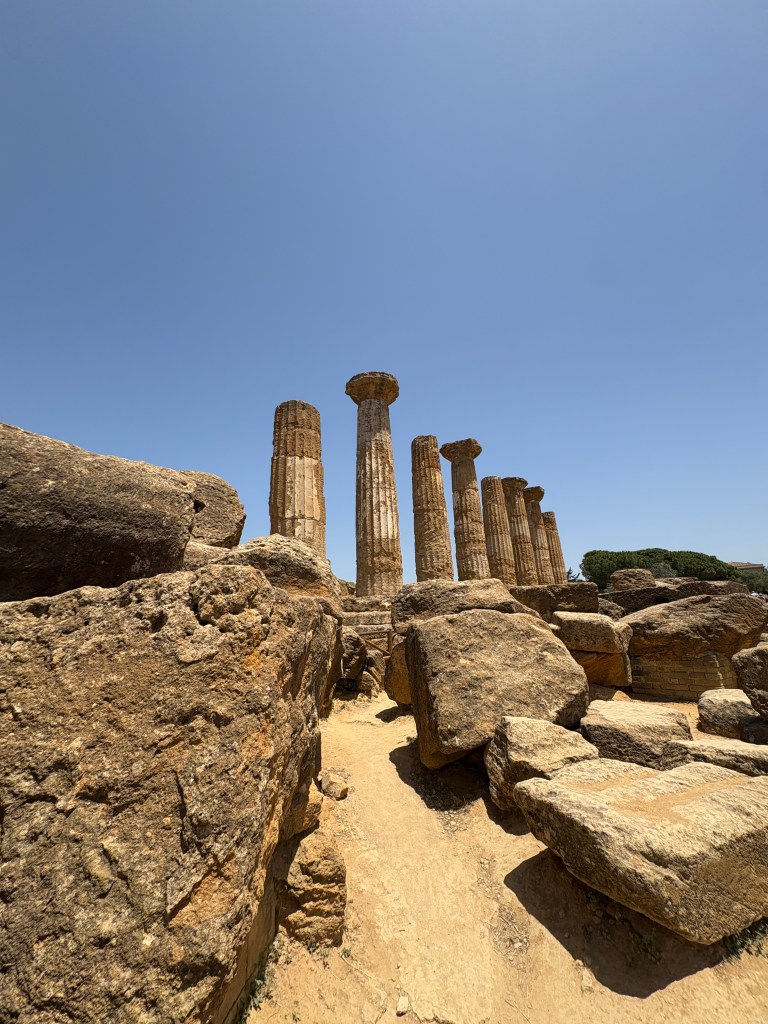
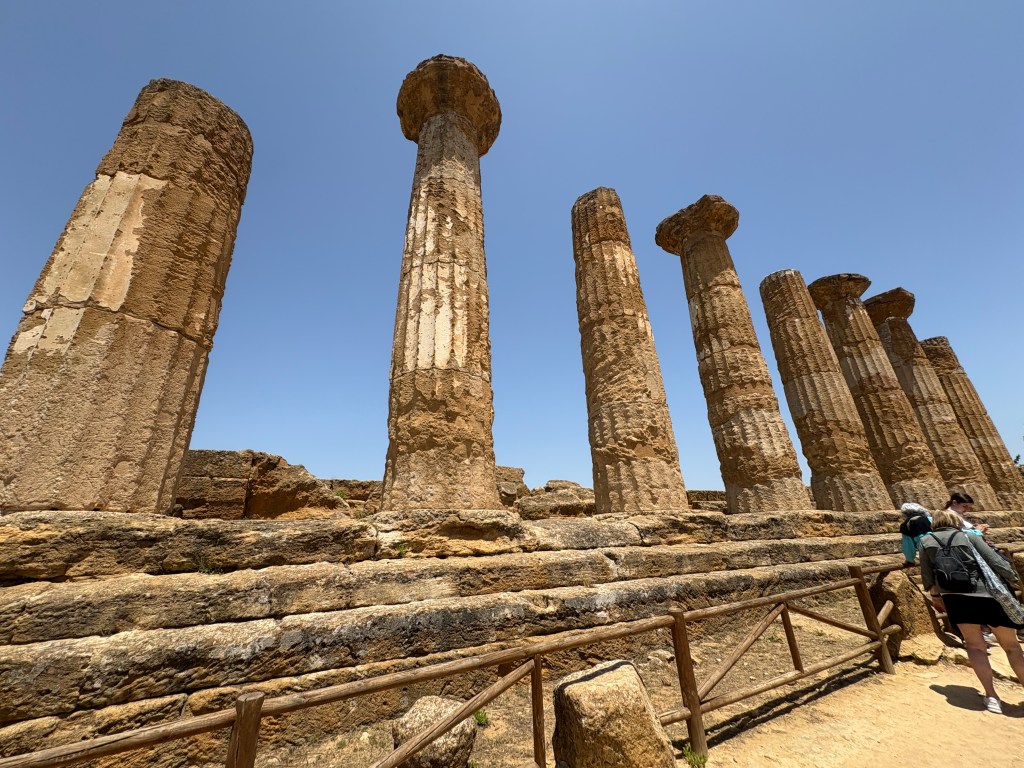
Giovanna encouraged us to take a moment to photograph the Temple of Concordia — but not head-on. She explained that the ancient Greeks loved to design their temples to be admired from the side, where the full depth and rhythm of the columns come to life. It wasn’t just about grand frontal entrances; it was about movement, perspective, and the interplay of light and shadow along the length of the structure.
This small insight felt like a secret shared — a way to connect more deeply not just with the temple itself, but with the intentions of those who built it thousands of years ago.
When I thought about this idea of experiencing a temple from the side, I immediately thought of the Greek sculptural technique called contrapposto — where a figure stands with weight shifted onto one leg, creating a natural, relaxed S-curve. Contrapposto was revolutionary because it captured movement and balance, moving away from rigid, symmetrical poses.
In a similar way, Greek temples weren’t just static monuments meant to be admired from one angle. They were designed to engage viewers dynamically, inviting them to walk around and experience the rhythm and harmony of the structure from multiple perspectives. Beauty, as we know it, doesn’t exist in absolutes — it thrives in a multitude of perspectives, shaped by countless factors, and inspires a variety of reactions in those who behold it.
This philosophy wasn’t unique to the temples of Agrigento. The Parthenon in Athens, the most famous Greek temple of all, was also created with the understanding that visitors would move around it, appreciating the columns’ rhythmic procession and the sculptural narratives that unfold in the round. From the side, the Parthenon’s proportions and harmony reveal themselves in ways a frontal view can’t capture.
Both the technique of contrapposto in sculpture and the architectural design of temples reflect the Greeks’ deep fascination with movement, balance, and naturalism — whether in human form or in stone. It’s a reminder that ancient art wasn’t about freezing moments in time, but about capturing life in its fullest, most fluid expression.
Standing there, guided by Giovanna’s words, I felt a new kind of connection to the past — one that honors not just the physical ruins, but the vision and lived experience of those who created them.
In the end, the Valley of the Temples isn’t just a place frozen in time. It’s a living palimpsest — layers of fact and feeling, scholarship and storytelling, all etched into the landscape. I came with no expectations, yet left carrying a quiet understanding: that meaning is not something we simply find here. It’s something we enter into — through language, memory, and the eyes of someone who calls this place home.
 writingaboutpaintings
Leave a comment