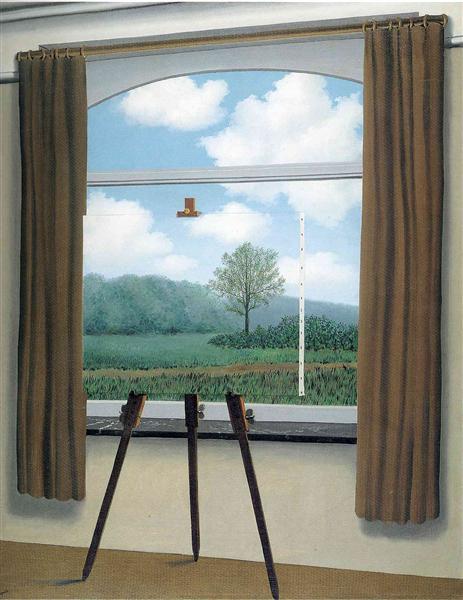
My art colleagues and I are relatively new to grading visual analysis papers. Consequently, there have been many passionate discussions about marking rubrics and the responses we encounter in examination scripts. One particularly memorable disagreement concerned René Magritte’s The Human Condition.
A student proposed that behind the easel, which blends almost seamlessly into the landscape, might lie something sinister: negativity, unpleasant emotions, or disturbing symbols. I thought this was a rather astute interpretation, especially when most of the other students had confined their responses to identifying objects visibly represented within the frame.
My colleague disagreed. He argued that if we allowed students to write about things that could not be seen, visual analysis would become something of a free-for-all.
I disagreed in turn. Surely, in art history, we are expected to make connections, draw inferences, and contemplate what lies beyond the visible image? After all, an artwork’s meaning is not necessarily confined to the objects represented within its frame.
I offered Leonardo da Vinci’s Mona Lisa as a simple example. Her gaze appears to meet ours, establishing a relationship with a spectator who is not physically represented in the painting.
I was fairly certain I could have produced a million other examples had I not been navigating such a stressful period at work.
So, here goes.
1. The Visible Is Not the Limit of Meaning
Let us return to the example I offered my colleague.
In Leonardo da Vinci’s Mona Lisa, her outward gaze seems to meet our own. The viewer is not represented within the painting, yet our presence completes the experience of that gaze. We become participants in a visual exchange despite remaining physically absent from the composition.
Conversely, in Magritte’s The Human Condition, we are invited to contemplate what might exist behind the represented surface. The painting depicts an easel positioned before a window, its painted landscape appearing to merge seamlessly with the scenery beyond.
The painting-within-a-painting device, so characteristic of Magritte’s exploration of representation and reality, raises questions about what is concealed. We see what the easel presents to us, but we cannot independently verify what lies behind it.
What is visible, therefore, becomes the very thing that draws our attention towards what is not.
I would even go so far as to suggest that absence can function as an artistic device in its own right.
Consider Magritte’s The Lovers (1928), in which two figures kiss through fabric that conceals their faces. Although the lovers are physically present, their identities and expressions remain inaccessible. The visible act of concealment invites us to contemplate the unseen emotional and psychological dimensions of their relationship.
Another fascinating example is Diego Velázquez’s Las Meninas (1656).
The royal couple, King Philip IV and Queen Mariana, appear as reflections in a mirror on the back wall. Their physical location is not directly revealed, although one influential interpretation places them outside the depicted scene, approximately where the spectator stands.
Even more intriguingly, several figures look outward, seemingly acknowledging a presence beyond the picture plane.
The painting thus creates an extraordinary relationship between the depicted figures, the unseen space beyond the frame, and ourselves as spectators.
The unseen is hardly irrelevant to the composition. On the contrary, it may be fundamental to how we understand it.
2. The Artist’s Intention Is Not Necessarily the Final Word
Does an artwork’s meaning belong exclusively to its creator?
The spectator is not a passive observer, nor does a painting necessarily communicate one fixed meaning to every viewer.
Our memories, experiences, fears, desires, and cultural backgrounds influence how we interpret images.
John Berger explores this relationship in Ways of Seeing (1972), particularly through his argument that what we see is shaped by what we know and believe.
Looking is therefore never an entirely neutral activity. We bring our own histories and assumptions into our encounters with artworks.
We do not merely discover meaning in art; we also participate in its construction.
A related argument can be found in Roland Barthes’ influential essay The Death of the Author (1967).
Barthes challenges the assumption that the author’s intentions should serve as the ultimate authority over a text’s meaning. Instead, he emphasises the role of language, culture, and the reader in producing meaning.
One of his most memorable declarations is:
“The birth of the reader must be at the cost of the death of the Author.”
Although Barthes was writing about literature, his argument offers an intriguing perspective on the interpretation of visual art.
If meaning does not belong exclusively to the creator, then an artwork may acquire significance beyond what its artist consciously intended.
The spectator may discover relationships, contradictions, implications, and absences that are not explicitly explained by the artist.
This does not mean that every interpretation is equally convincing. Rather, it suggests that artistic meaning is not necessarily exhausted by authorial intention.
The artist may initiate the conversation, but the spectator helps sustain it.
3. The Art of Withholding: When Absence Becomes Presence
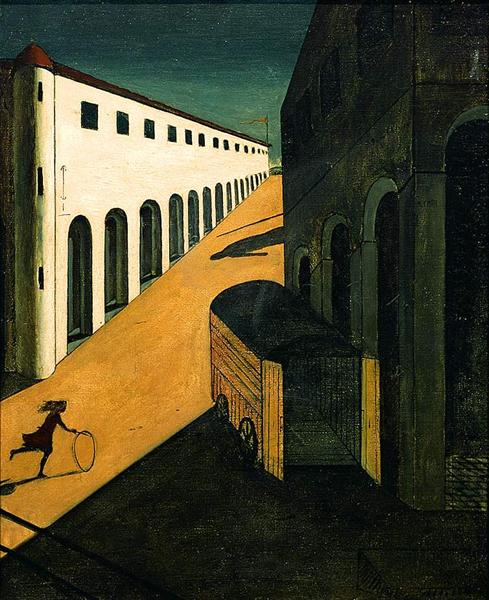
In Giorgio de Chirico’s Mystery and Melancholy of a Street (1914), a young girl runs through an eerily deserted street, rolling a hoop.
An enormous shadow stretches across the ground, suggesting the presence of a figure who remains outside the visible composition.
Curiously, the visible child seems almost secondary to the invisible figure whose presence we experience through the dark, looming shadow.
One could even argue that the invisible overpowers the visible in this painting.
We cannot identify the figure casting the shadow. We do not know its intentions, or whether the child is in any danger at all. Yet the shadow introduces an unsettling sense of anticipation, compelling us to imagine a narrative that the painting never explicitly reveals.
Ironically, the absence of the figure seems to make its presence all the more powerful.
And here is another possibility: could the shadow even belong to us, the spectators?
Its angle invites us to consider whether we might occupy the space beyond the picture frame, becoming an unseen presence within the painted narrative.
Suddenly, we are no longer merely observers of a potentially threatening encounter. We might ourselves be implicated in it.
What fascinates me is how the painting encourages us to construct meaning around something that is not physically represented.
The shadow is visible, but its source is not. The painting gives us just enough information to begin imagining what might exist beyond the frame.
This brings me back to the student’s interpretation of Magritte’s The Human Condition.
Art history requires evidence, but evidence need not extinguish imagination.
There is, of course, a distinction between an imaginative interpretation grounded in visual evidence and an arbitrary claim. In de Chirico’s painting, the shadow offers a visible indication of something outside the composition. In Magritte’s painting, the easel establishes an equally visible act of concealment, although the nature of what might be concealed remains uncertain.
My student’s suggestion that something negative or unpleasant lies behind the easel may not be the only possible interpretation, nor can it be established as fact. Nevertheless, the visual ambiguity of Magritte’s composition provides a starting point for considering what might lie beyond the represented surface.
Surely, the task of visual analysis is not merely to identify what is immediately apparent, but also to investigate the possibilities suggested by what we see?
If imaginative interpretations can be supported by visual evidence, then evidence becomes not a restriction on imagination, but the very foundation from which it begins.
An apparent absence may become the beginning of an interpretation.
And perhaps this leads us to a larger question:
Can what an artist deliberately withholds be as important as what the artist chooses to represent?
Or, more provocatively, might something absent from an artwork acquire meaning through the very act of our looking?
I return, then, to the disagreement that inspired this reflection.
Perhaps my student’s interpretation might be challenged because of the basis of it’s premise. But I wonder whether insisting too rigidly upon what is immediately visible risks overlooking one of the most fascinating possibilities of art: its capacity to suggest, evoke, and communicate what it does not explicitly show.
After all, if we only ever looked at what was directly in front of us, how much would we fail to see?


Leave a Reply